

Roughly 11% of the take-home submissions we scored between spring 2023 and fall 2025 came back with an AI score above 0.8. The percentage isn't the interesting part. The interesting part is the band between 0.6 and 0.8, where our four instructors and the detector agreed on barely half the cases.
We run AI-generated code detection on every submission as a matter of routine. It sits in the same pipeline as peer similarity and web matching, which matters later in this piece. What follows is what 4,312 submissions across five cohorts actually looked like, and what we changed because of them.
How we scored 4,312 take-home submissions
Some context, because a distribution with no context is marketing. Our program runs twelve weeks of backend work, about 175 students per cohort, and five take-home assignments per cohort. Roughly 4,300 submissions survived the late policy and the dropouts. Python accounted for 68% of the corpus, JavaScript and TypeScript 24%, Java the remaining 8%.
Every submission went through the same three checks in one pass: an AI code detector for generation signals, a source code plagiarism checker against the rest of the cohort, and a web/GitHub scan for anything lifted from a tutorial or a public repo. Instructors then blind-reviewed a stratified sample of 532 submissions, including 412 from the 0.6-and-above band and 120 drawn from below it as a control. Two raters per submission, disagreements escalated to a third.
That review layer is the whole point. The scan tells you where to look. It doesn't tell you what happened.
The AI detection score distribution is bimodal, not normal
I expected something Gaussian-ish, a fat middle of "partly assisted." We got a U shape with a long flat shelf in the middle.
| AI score band | Share of 4,312 submissions | Instructor agreement |
|---|---|---|
| 0.00 to 0.19 | 58.3% | 91% (sampled) |
| 0.20 to 0.39 | 15.1% | not sampled |
| 0.40 to 0.59 | 8.4% | not sampled |
| 0.60 to 0.79 | 7.0% | 54% |
| 0.80 to 1.00 | 11.2% | 88% |
Read the 0.60 to 0.79 row twice. That's the shelf, and it's where the tool is least decisive and where we burned the most instructor hours. At 0.85 the conversation is usually short. At 0.68 you're reading code line by line trying to decide whether a student who writes clean code is suspicious or just, well, a student who writes clean code.
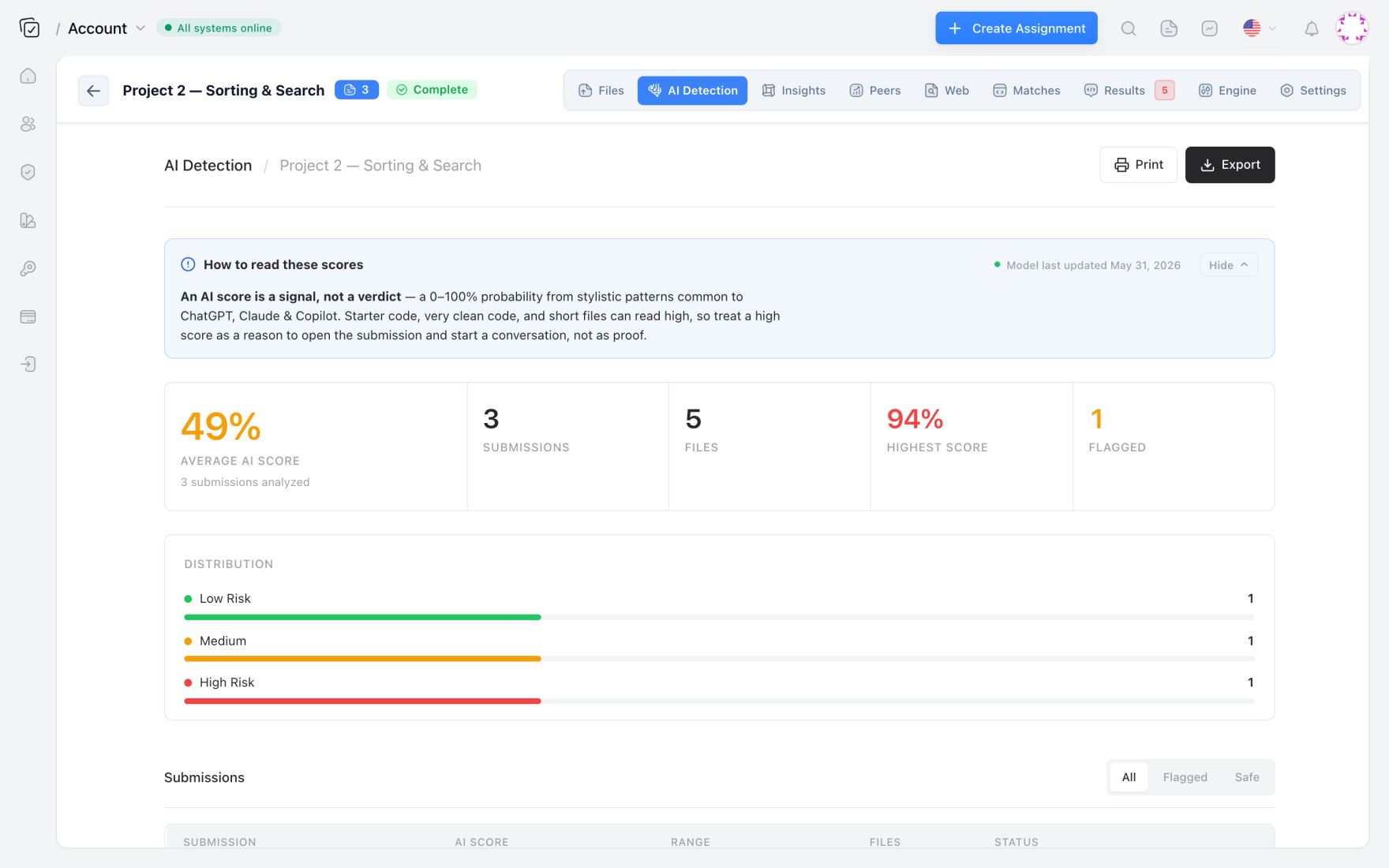
The drift over time is worth flagging: the 0.80+ share went from 6.1% in the spring 2023 cohort to 15.4% in fall 2024, then down to 11.9% in fall 2025. I have theories about the 2024 bump (GPT-4o-era autocomplete everywhere, plus a cohort that had clearly shared notes) and no proof. The 2025 decline tracks with a redesign I'll get to.
What actually separated the high scorers
Forget detector internals for a second. Here's what a human sees. The signature isn't sophistication. It's unrequested thoroughness.
A student working through a median-of-a-list exercise for the first time does not guard against the empty-list case unless the spec mentions it. They do not write a three-line docstring above a four-line function. They name the variable after the assignment, not after the type system.
# Typical human submission, week 4
def avg(nums):
    total = 0
    for n in nums:
        total += n
    return total/len(nums)
# Typical high-scoring submission
def calculate_average(numbers: list[float]) -> float:
"""Calculate the arithmetic mean of a list of numbers.
Args:
numbers: A list of numeric values.
Returns:
The arithmetic mean, or 0 if the list is empty.
"""
if not numbers:
return 0.0
return sum(numbers) / len(numbers)The second one guards the empty list (spec never asked), annotates types in a 40-line script, imports nothing it uses, and writes a docstring with an Args block. Add `if __name__ == "__main__":` to a file nobody imports, uniform comment density around one comment per four lines, and generic identifier names (`data`, `result`, `temp`, `item`) and you have most of our 0.80+ set.
The strongest signal we found wasn't in the code's logic. It was in the code's manners.
Human beginners have a different fingerprint: domain-flavored names (`quiz_scores_2`), a hardcoded `/Users/.../test.csv` left in, a `print("here")` that survived to submission, and one commented-out block they were afraid to delete.
Where AI code detection was wrong
Three false positive clusters, in descending order of how much they annoyed me.
Our own starter repo. In 2023 we shipped students a scaffolding package that we had partly generated with Copilot and never audited. The top AI-scored file across 340 submissions was not a student file. It was our `utils.py`, present, mostly unedited, in a third of the cohort. The detector was right that a machine wrote it. We were the machine. If you audit nothing else this term, audit the boilerplate you hand out.
Non-native English writers with style guides. A student who was told in week one to document every function documents every function. Verbose docstrings correlate with AI scores in a way that has nothing to do with generation, and I've watched instructors make that mistake in a live review.
Textbook-shaped assignments. When the spec is "implement a stack," the correct answer looks like every stack ever written, including the ones in training data. The detector isn't confused. The assignment is just generically solvable.
AI-assisted versus AI-generated, and where we drew the line
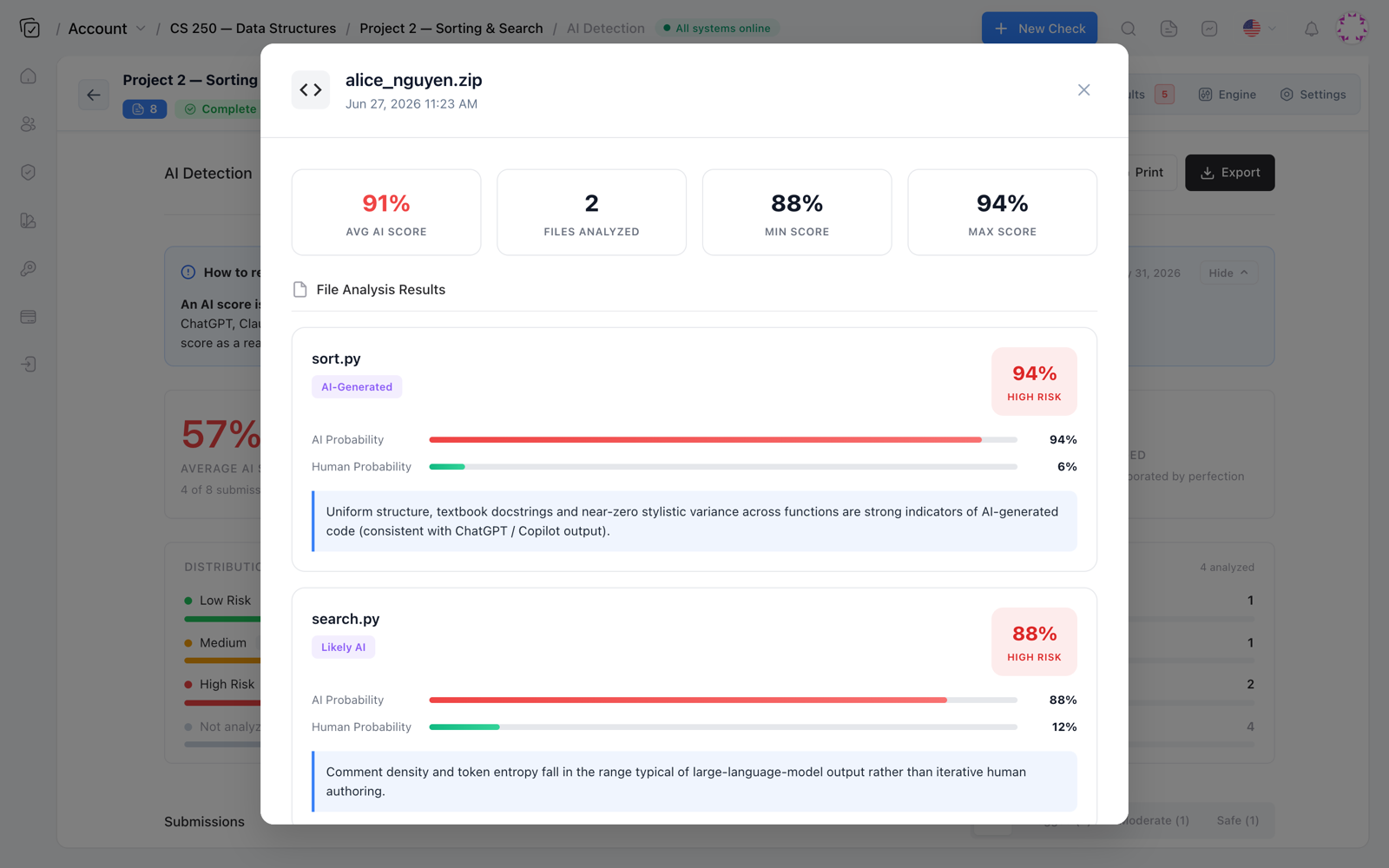
Our policy, after two rounds of argument: we don't adjudicate on the score. We adjudicate on the conversation. Any submission above 0.8, or any submission a reviewer flags for texture, triggers a fifteen-minute walkthrough where the student explains a function and then modifies it live while I watch. Change the requirement mid-sentence. Ask what happens on an empty input.
Kids who wrote the code get faster under questioning. Kids who didn't get slower and vaguer, and it takes about ninety seconds to tell. The detector gets us to the interview. It doesn't get us to the verdict, and I'd push back hard on any policy that skips the interview.
We do permit AI use in one assignment, a refactoring exercise, with a disclosure file listing which lines came from a model. Roughly 30% of students disclose something. The disclosure rate is honest and the scores there don't matter, which is the point: give students a legitimate channel and the covert channel gets quieter.
Stacking peer, web, and AI signals in one pass
The single most useful thing we learned is that each check is blind in a different direction. Peer similarity sees two students copy each other and sees nothing when 40 of them copy a Stack Overflow answer. Web matching catches the tutorial lift and misses a Claude-generated solution to a problem nobody has posted. AI detection catches generation and is useless against a hand-typed copy from GitHub.
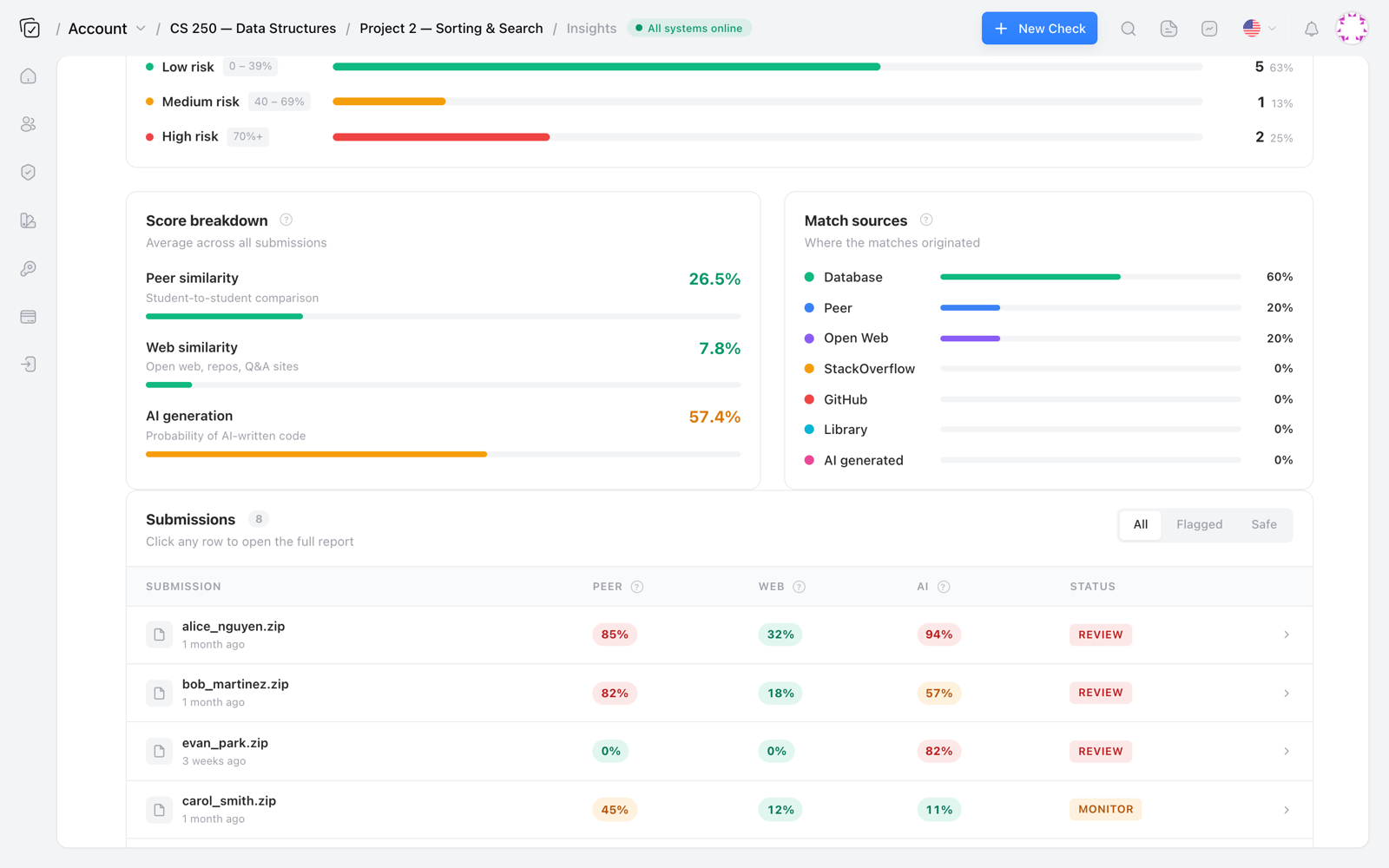
That's the practical argument for running all three in one job rather than three tools. We've used MOSS for years and it still does pairwise similarity as well as anything. JPlag 5.x handles our Java fine. Dolos 2.x is pleasant for the JS side. None of them score generation, and none of them tell you that line 44 came from a specific GitHub file. Moving to a code plagiarism checker that produces peer, web, and AI scores from a single submission set cut our triage pass from a full day to about two hours per assignment, mostly because we stopped stitching CSVs together.
Honest caveat: we haven't validated the 0.6 to 0.8 band against a large enough human-rated sample to say anything confident about it. Our 54% agreement figure rests on 412 reviews, four raters, and no proper inter-rater reliability work until cohort three. Treat that number as a direction, not a measurement.
What we changed in the assignments
The old take-home was "build a URL shortener with tests." Perfectly good assignment, and roughly the most LLM-solvable prompt in existence. The new one is "extend this 400-line repo we wrote, which logs through an internal helper called `L`, uses our own config loader, and has one deliberately odd naming convention. Add this feature, which touches both `scheduler.py` and `retry.py`. Write 200 words on a tradeoff you made."
A generic model completion produces code that ignores our conventions entirely. Not because it's bad, but because the constraints aren't in the prompt. We also grade the commit history now: two commits, one of them 600 lines, submitted at 3 a.m., is a different artifact than twelve commits over four days. Not proof of anything. Just texture.
Should you do all of this? Probably not all. If you take one thing from five cohorts of data, take this: the score is a routing decision, not a verdict, and the assignments you write determine whether that routing decision is even useful. A prompt that any model can satisfy in one shot gives you a detector score and nothing else to reason about.
If you want to see what the three-signal view looks like on your own course, our code plagiarism checker for teachers walks through the setup we use, and the Codequiry dashboard will run your first assignment set free.