Code plagiarism checker for teachers
Upload the class after the deadline and get the few submissions worth a closer look at the top, whether the code came from a classmate, last term, GitHub or ChatGPT. Each one opens the matching lines side by side, so you have something concrete to talk to the student about.
2-day free trial. Checks every file against classmates, the web and AI, in 65+ languages.
stats.pystats.pyRenamed (highlighted), but both skip the last gap in the list (underlined). Honest students rarely share a mistake. It is a good question to ask both of them.
Used in programming courses at






How it works
- Create the assignment and add any starter code, so it never counts as a match.
- Upload the submissions as a ZIP, or pull them from Canvas, Moodle or your LMS.
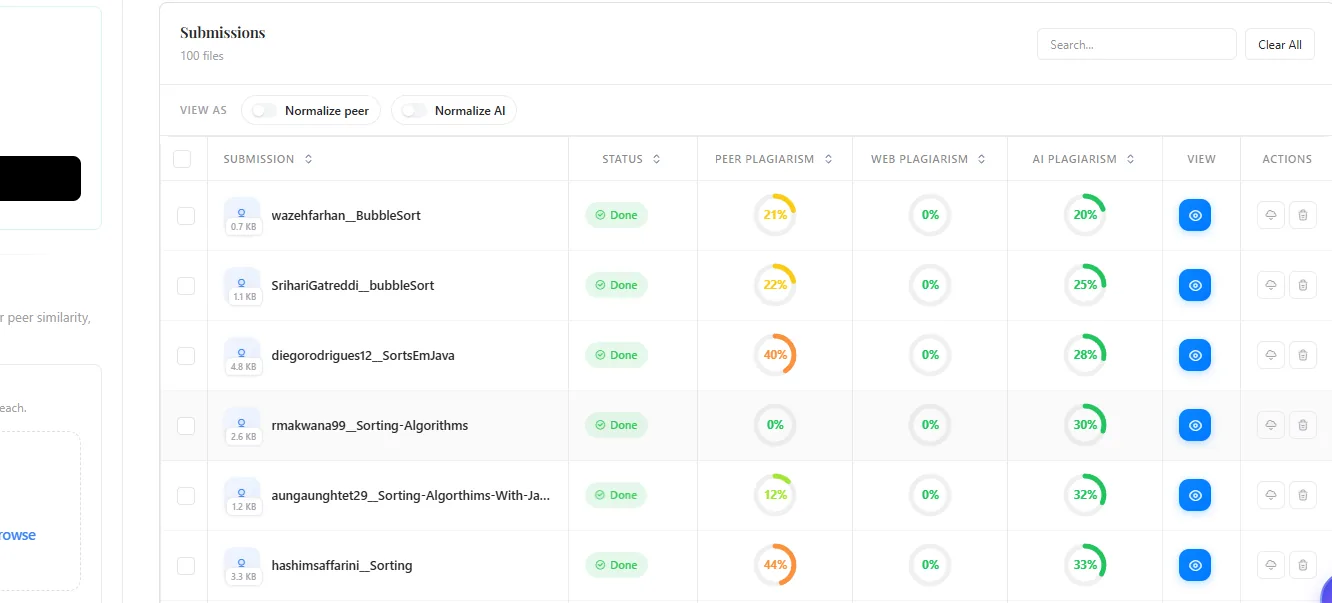
- Read the list. Results come back in minutes, sorted by score. Most of the class sits at the bottom with nothing to review.
- Open what stands out. The two files sit side by side with the shared lines marked, or the web source is linked, or the AI finding lists its reasons.
What it checks
Classmates
Every submission against every other, by structure, so renamed and reformatted copies still match.
Past terms
Earlier submissions to your course, for solutions handed down from last year.
The web
GitHub, Stack Overflow and the indexed web, with a link to the source.
AI-written code
ChatGPT, Claude, Gemini and Copilot, with the reasons shown. More on AI detection.
MOSS and JPlag only do the first of these. If that is what you use today, here is what changes.
How common it is
In the last seven days Codequiry checked 230 submissions and flagged 128 at 70% similarity or more: 61 matched code already online and 75 matched another student's work.
Two recent flags
submission.java
100%
submission.c
93%
Real flags from Codequiry. Student names, comments and strings are removed before anything is shown here.
Talking to a student about a match
The checker finds the matches. What happens next is up to you, and it is what students remember.
- Read the lines first. Discount starter code, very short programs and textbook algorithms, which can match between honest students.
- Look for what is hard to share by accident: the same bug, the same odd name, the same unusual structure, the same dead code.
- Ask them to explain it. A student who wrote the code can walk through it and change it. That conversation settles most cases either way.
- Keep the report. Export the side-by-side evidence if the case goes further.
There is a longer walkthrough in how to detect code plagiarism.
Check this week's assignment
Upload the class as a ZIP. Results come back in minutes.
2-day free trial
Fits your course
- 65+ languages, from Python and Java to C, SQL and Jupyter notebooks.
- Your LMS: Canvas over LTI 1.3, plus Moodle, Blackboard, Brightspace and Schoology.
- Your terminal, if you prefer it: a command-line client and a desktop app for batch uploads.
- While students write: Window, a free student IDE that records pastes as they happen.
What other instructors say
“The rise of AI-generated code has made verifying student mastery a critical challenge. Codequiry is now essential for upholding our academic standards and ensuring every submission represents original effort.”
“We found a 99% match between a student and a Chegg solution. I can't believe CS departments are missing this.”
Frequently asked questions
How do I check my students' code for plagiarism?
Upload the class's submissions as a ZIP, one folder or file per student, or pull them from your LMS. Every file is checked against the rest of the class, earlier terms, the web and AI, and the results are sorted so the highest scores come first.
What score counts as plagiarism?
None on its own. A score tells you where to look. Read the matched lines, discount starter code and very short programs, and talk to the student before deciding anything.
Can it tell if a student used ChatGPT?
It can flag code that is likely AI-written, with the reasons behind it. Treat it as a reason to ask the student to explain their code, not as proof. Whether AI is allowed is your course's rule to set.
Will it flag the starter code I gave out?
No. Upload the starter code with the assignment and matches against it are left out.
Do my students need accounts?
No. You upload their work, or they submit through your LMS or Window, the student IDE. Only you need an account.
Does it work with Canvas or Moodle?
Yes. Canvas connects over LTI 1.3, and Moodle, Blackboard, Brightspace and Schoology are supported too.
How much does it cost?
There is a free check for comparing up to 20 submissions with each other, a single full check for $50, and plans for regular use with a 2-day free trial. See the pricing page for current plans.
See what's in your class's code
Every submission against classmates, past terms, the web and AI, with the lines side by side.
Start free trial2-day free trial
Just one assignment? Run a single check