Code plagiarism detection software for universities
One account for the department. Every course, section and term checked against each other, the web and AI, connected to your LMS, with evidence that holds up when a case reaches the integrity office.
2-day free trial. Checks every file against classmates, the web and AI, in 65+ languages.
| Submission | Peer | Web | AI | Why it stands out |
|---|---|---|---|---|
| Section 3 · Student 202 | 8% | 97% | 5% | Copied from a public GitHub repo |
| Section 2 · Student 031 | 91% | 3% | 6% | Matches a student in Section 4 |
| Section 4 · Student 118 | 91% | 5% | 4% | Matches a student in Section 2 |
| Section 2 · Student 054 | 4% | 6% | 88% | Likely AI-written, reasons listed |
| Section 1 · Student 007 | 84% | 2% | 3% | Matches a submission from last year |
One course, four sections, checked as one. Copying between sections and from past years only shows up when everything is compared together.
Used in programming courses at




One account, every course
Plagiarism checking in a CS department usually lives with whoever set up MOSS years ago. Codequiry gives it a home the whole department can use:
- Courses stay organized. Each course keeps its own assignments and results.
- Teams share the work. Invite colleagues and teaching assistants and choose who sees which checks, so review does not fall on one person.
- Sections and terms connect. Submissions are compared across sections and against earlier years, where handed-down solutions come from.
What every check covers
Classmates and sections
Every submission against every other, by structure, so renamed and reformatted copies still match.
Past terms
Earlier submissions to the course, so a solution passed down from last year is caught.
The web
GitHub, Gists, Stack Overflow, Software Heritage and the indexed web, with a link to each source.
AI-written code
A detector trained on ChatGPT, Claude, Gemini and Copilot output, with its reasons shown. How it was tested.
All in 65+ programming languages, with starter code left out and common boilerplate labeled.
Evidence for a hearing
A misconduct case needs more than a percentage. Every flag opens what is behind it:
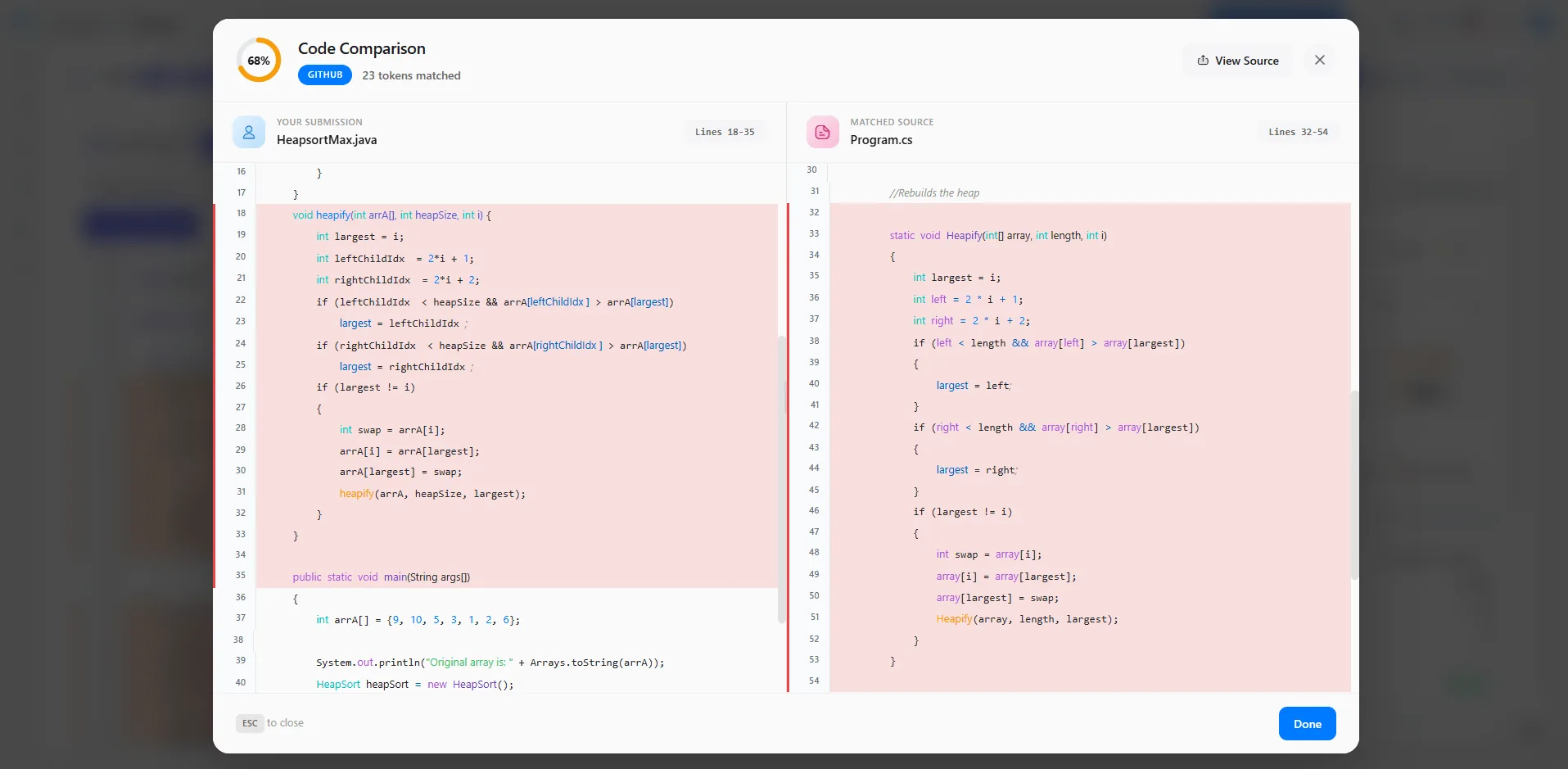
- The matched lines, side by side, for classmates, past terms and web sources.
- The source of every web match, linked.
- The reasons behind every AI finding, so it can be weighed rather than taken on trust.
- An exportable report that stays in your account after the term ends.
A score starts a review. It does not decide one. Short programs and common algorithms can match between honest students. The report gives a person what they need to judge the case.
Fits your systems
- LMS. Canvas over LTI 1.3, plus Moodle, Blackboard, D2L Brightspace and Schoology.
- Automation. A REST API with SDKs, a command-line client for autograders, and a desktop app for batch uploads.
- Supervised work. Window is a student IDE that records pastes and focus changes, for courses that care how code was written.
Try it on one course first
Run last term's assignments through it and compare with what you caught.
2-day free trial
Student data
- FERPA. Codequiry acts as a school official with a legitimate educational interest, uses student data only for plagiarism detection, and limits access to authorized educators. See the privacy policy.
- GDPR. How EU institutions are covered is on the EU compliance page.
- China and India. Separate pages cover PIPL, CSL and DSL and the DPDP Act.
- Students need no accounts. Work arrives through your upload, your LMS or Window.
Buying for a department
Instructors can start on their own with a standard plan. For a department or campus, talk to us about an agreement sized to your courses, including FERPA terms.
What instructors say
“Teaching over 500 students per term, we faced a critical challenge: detecting code copied from ChatGPT and online sources without viable tools. Codequiry enables us to batch-process entire cohorts efficiently.”
“The rise of AI-generated code has made verifying student mastery a critical challenge. Codequiry is now essential for upholding our academic standards and ensuring every submission represents original effort.”
Frequently asked questions
What is code plagiarism detection software?
Software that compares students' source code to find work copied from classmates, earlier terms, the web or AI. It compares program structure rather than text, so renaming variables and reformatting do not hide a copy.
Can a whole department share one account?
Yes. Invite colleagues and teaching assistants to your team and choose who can see which checks. Each course keeps its own assignments, and submissions can still be compared across sections and terms.
Does it integrate with our LMS?
Yes. Canvas connects over LTI 1.3 (LTI 1.1 also works), and Moodle, Blackboard, D2L Brightspace and Schoology are supported. There is also a REST API for anything else.
Is Codequiry FERPA compliant?
Codequiry acts as a school official with a legitimate educational interest under FERPA, uses student data only for plagiarism detection, and limits access to authorized educators. Institutions can contact us for a FERPA agreement.
What about GDPR and other data laws?
EU institutions can read how Codequiry meets GDPR on the EU page. There are separate pages for China's PIPL, CSL and DSL and for India's DPDP Act.
Can reports be used in a misconduct hearing?
Yes. Every result can be exported with the matched lines side by side and the source of each match, and the report stays in your account.
How does it compare with MOSS?
MOSS compares the submissions in one batch with each other. Codequiry does that too, and adds earlier terms, the web and AI detection, in 65+ languages, with a web app and LMS integration instead of a command-line script.
How is it priced for a department?
Individual instructors can start on a standard plan. For a department or campus, contact us for an agreement sized to your courses.
Start with one course
Check a real assignment against classmates, past terms, the web and AI, and see what it finds.
Start free trial2-day free trial
Just one assignment? Run a single check