Detect plagiarised and similar code across trillions of code sources on the web See what's new
Live · real detections

Plagiarism found this week

Every card is a real student submission our engines flagged this week — each a 70%+ match to public code. The matched lines are highlighted; comments, strings & secrets stay blurred.

13.1K+Matches flagged
693.7M+Lines of code scanned
172+Educators & students
PYsnippet_1.py Flagged
"""Student Name: Ryan CoelloDate: 7/1/26Program Name: Project 1Description: Program to calculate the mathematical functions of power, e^x, and sine.""" import math # ---------------------------------------------------------------------------# Helper functions# ---------------------------------------------------------------------------def mypow(base, exponent): """Returns base raised to the power of exponent (positive, negative, or zero).""" if exponent == 0: return 1 elif exponent > 0: result = 1 for _ in range(exponent): result *= base return result else: return 1 / mypow(base, -exponent) def factorial(n): """Returns n! (n factorial) for a non-negative integer n.""" result = 1 for i in range(1, n + 1): result *= i return result def save_to_file(content): """Appends the given content to output.txt.""" with open("output.txt", "a") as output_file: output_file.write(content + "\n\n") # ---------------------------------------------------------------------------# Power Function# ---------------------------------------------------------------------------def calculate_power(): try: base = int(input("Enter the base: ")) exponent = int(input("Enter the exponent: ")) except ValueError: print("Invalid input. Please enter integer values only.\n") return
Student code blurred
Caught copying from a public source
98% web match50 lines · 26 minutes ago
Near-verbatim copy — an automatic fail under most honor codes
JSsnippet_1.js Flagged
// Data listsvar countryNames = getColumn("Countries and Territories", "Country Name");var countryFlags = getColumn("Countries and Territories", "Flag");var regions = getColumn("Countries and Territories", "Region");var populations = getColumn("Countries and Territories", "Population");var unemployment = getColumn("Countries and Territories", "Unemployment");var anthems = getColumn("Countries and Territories", "National Anthem"); // Game listsvar availableCountries = []; // Countries not yet guessed correctlyvar incorrectCountries = []; // Countries guessed wrong // Variablesvar currentCountryIndex = -1;var streak = 0; // Initializes available countries to guess listfor (var i = 0; i < countryNames.length; i++) { appendItem(availableCountries, i);} // StartsetupNewRound(); // InputsonEvent("submit_btn", "click", function() { processGuess();}); // Functions function setupNewRound() { // stop previous anthem before starting a new one stopSound(); // choose whether to use incorrect or general country if (incorrectCountries.length > 0 && randomNumber(1, 10) <= 7) { var randomPointer = randomNumber(0, incorrectCountries.length - 1); currentCountryIndex = incorrectCountries[randomPointer]; console.log("from incorrect list"); } else { // Pick from the general countries var randomPointer = randomNumber(0, availableCountries.length - 1); currentCountryIndex = availableCountries[randomPointer]; } displayData(); playAnthem();}
Student code blurred
Caught copying from a public source
95% web match26 lines · 15 hours ago
Near-verbatim copy — an automatic fail under most honor codes
PYpasted_snippet.py Flagged
"""""""""Template for implementing QLearner (c) 2015 Tucker Balch Copyright 2018, Georgia Institute of Technology (Georgia Tech)Atlanta, Georgia 30332All Rights Reserved Template code for CS 4646/7646 Georgia Tech asserts copyright ownership of this template and all derivativeworks, including solutions to the projects assigned in this course. Studentsand other users of this template code are advised not to share it with othersor to make it available on publicly viewable websites including repositoriessuch as github and gitlab. This copyright statement should not be removedor edited. We do grant permission to share solutions privately with non-students suchas potential employers. However, sharing with other current or futurestudents of CS 7646 is prohibited and subject to being investigated as aGT honor code violation. -----do not edit anything above this line--- Student Name: Tucker Balch (replace with your name)GT User ID: tb34 (replace with your User ID)GT ID: 900897987 (replace with your GT ID)""" import random as rand import numpy as np class QLearner(object): """ This is a Q learner object. :param num_states: The number of states to consider. :type num_states: int :param num_actions: The number of actions available.. :type num_actions: int :param alpha: The learning rate used in the update rule. Should range between 0.0 and 1.0 with 0.2 as a typical value. :type alpha: float :param gamma: The discount rate used in the update rule. Should range between 0.0 and 1.0 with 0.9 as a typical value. :type gamma: float :param rar: Random action rate: the probability of selecting a random action at each step. Should range between 0.0 (no random actions) to 1.0 (always ra… :type rar: float :param radr: Random action decay rate, after each update, rar = rar * radr. Ranges between 0.0 (immediate decay to 0) and 1.0 (no decay). Typically 0.99. :type radr: float
Student code blurred
Caught copying from a public source
99% web match50 lines · 17 hours ago
Near-verbatim copy — an automatic fail under most honor codes

Codequiry caught every one of these — automatically, in minutes.

Run your class through the same engines and see what's hiding in your students' code — before it counts against them.

Catch it in your class free

1-day free trial · no charge during your trial · cancel anytime

Student? Make sure your code is clean before you hand it in — don't get caught by your professor. Check your own code free →

Real flagged code from recent Codequiry checks — matched lines highlighted, comments & most surrounding code blurred. Filenames shortened and identities removed.

See it in action

Find plagiarism matches across trillions of code sources

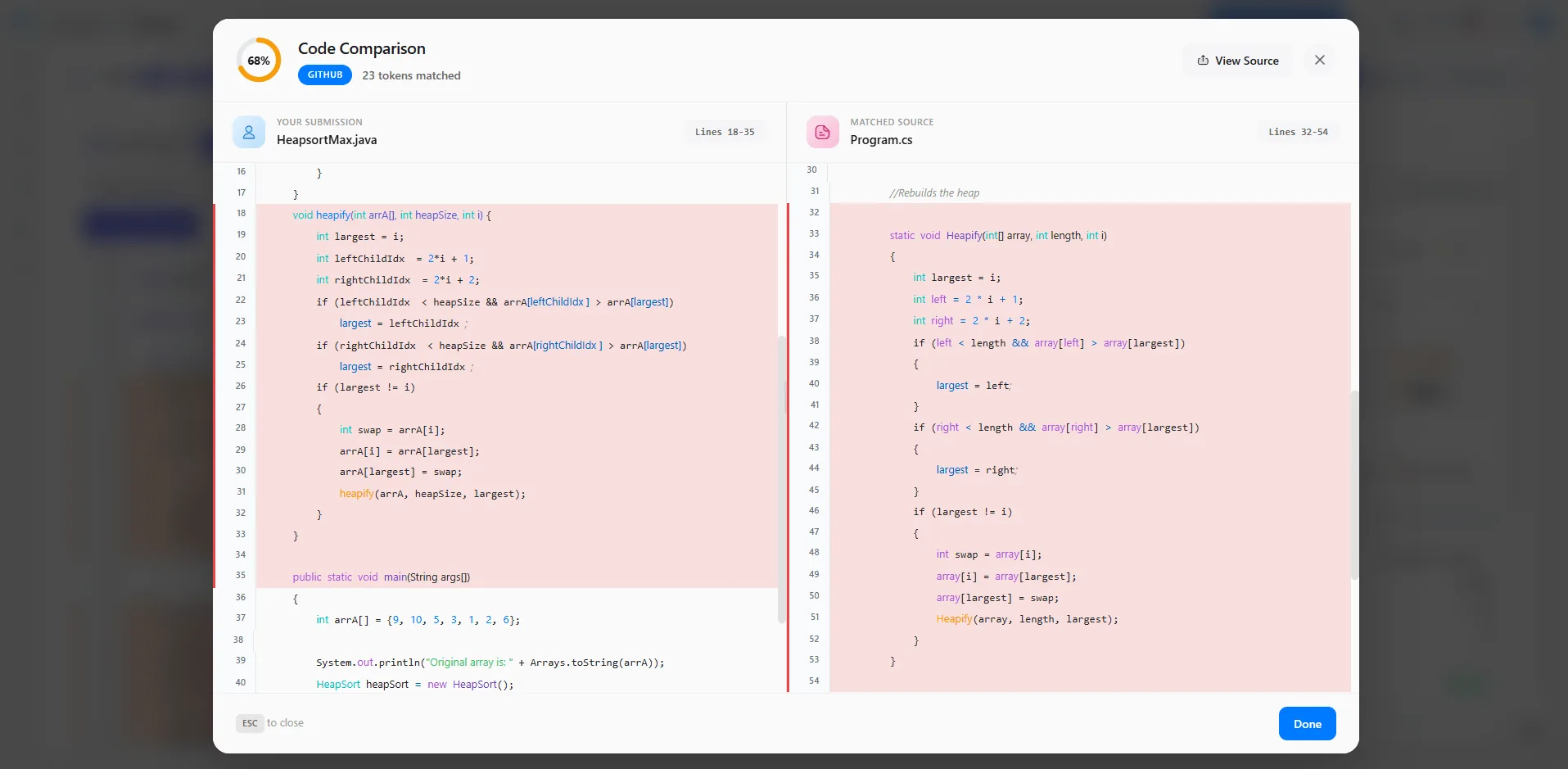
Every submission is checked against the open web, public repositories, every past student submission, and AI models — with the exact matched lines shown side by side.
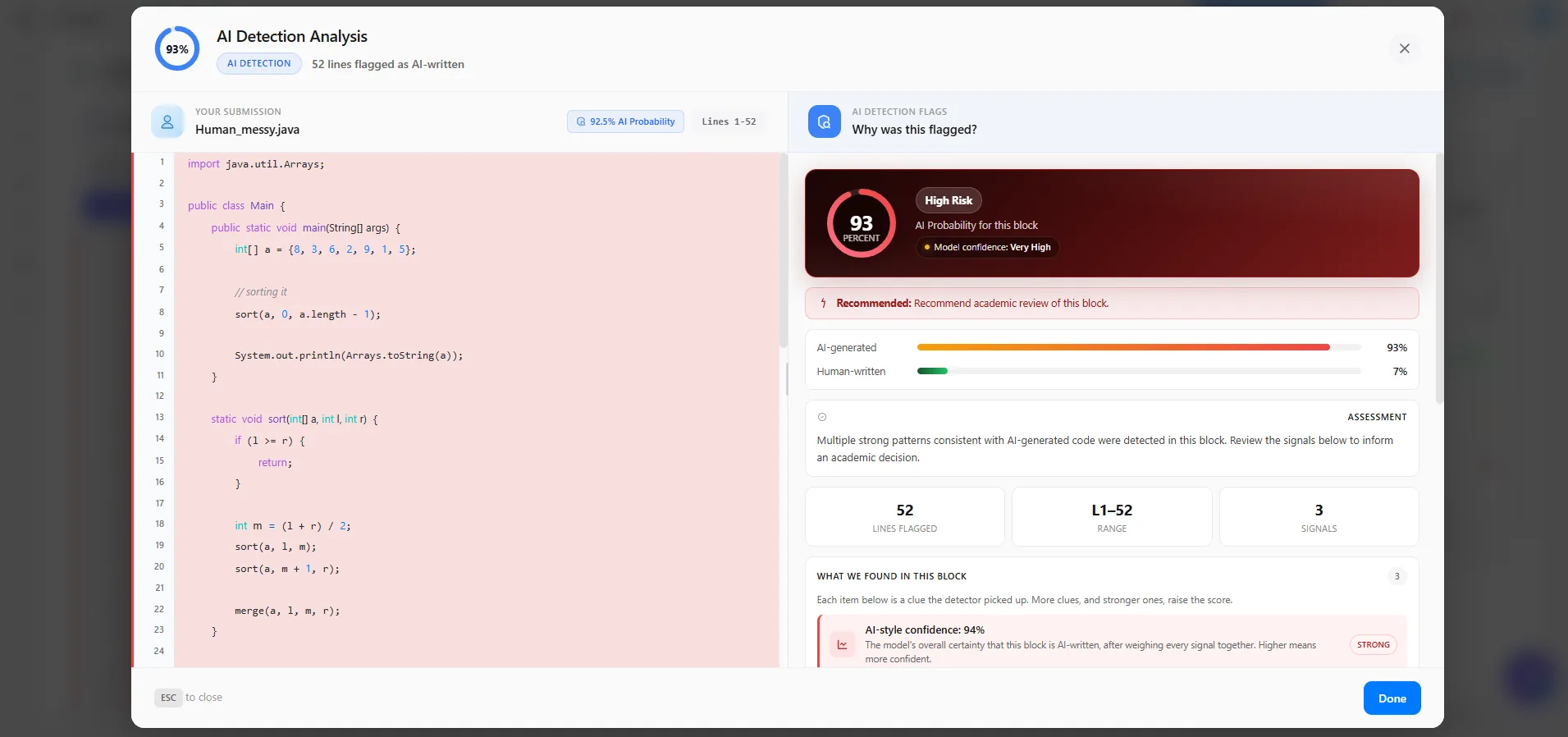
AI-written89%
Web & repo match92%
dashboard.codequiry.com/results/overview LIVE
Codequiry plagiarism detection dashboard showing student submission analysis
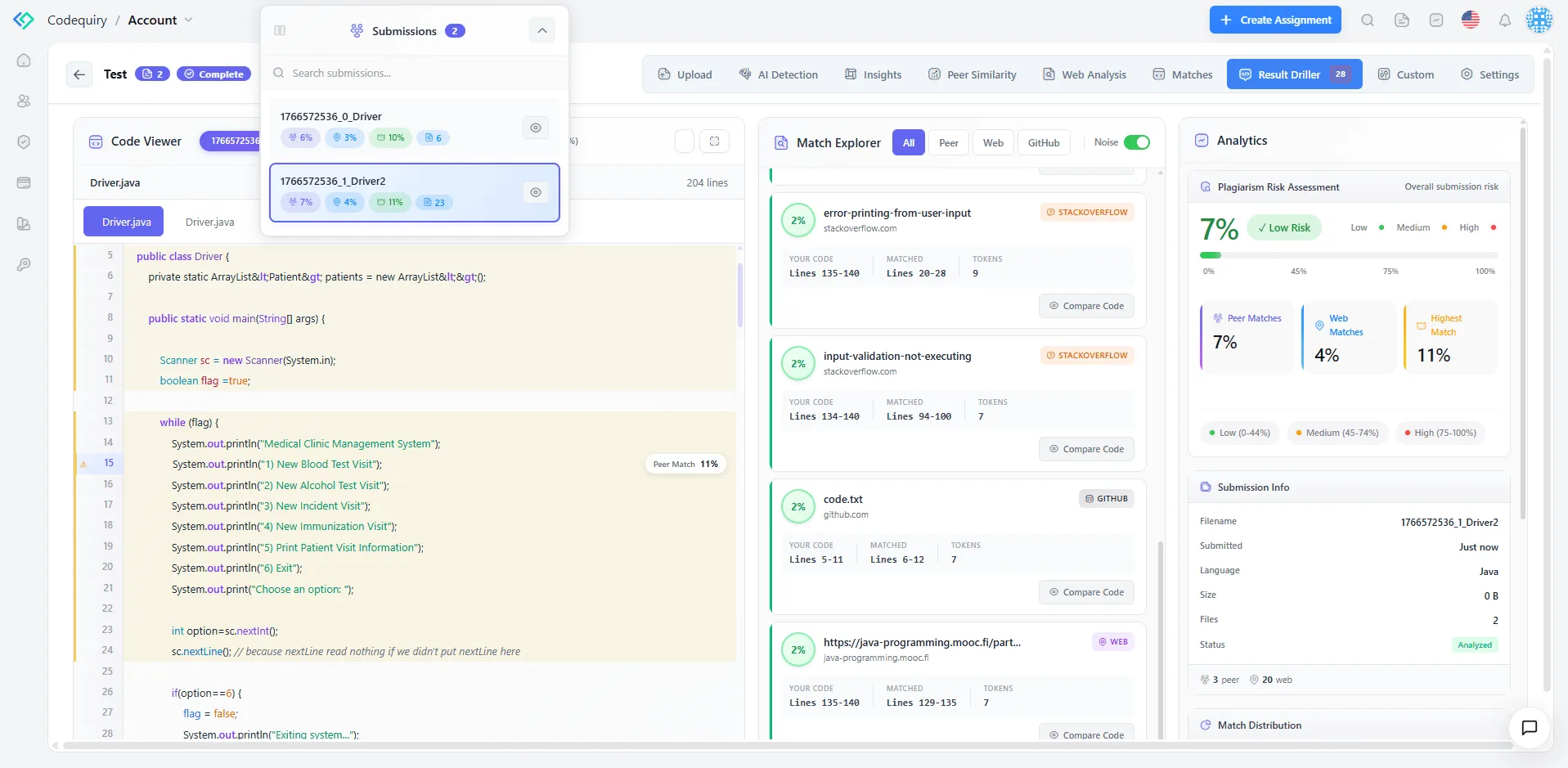
Side-by-side code comparison with highlighted plagiarism matches
AI detection analysis showing a code block flagged as AI-written with probability score and signals
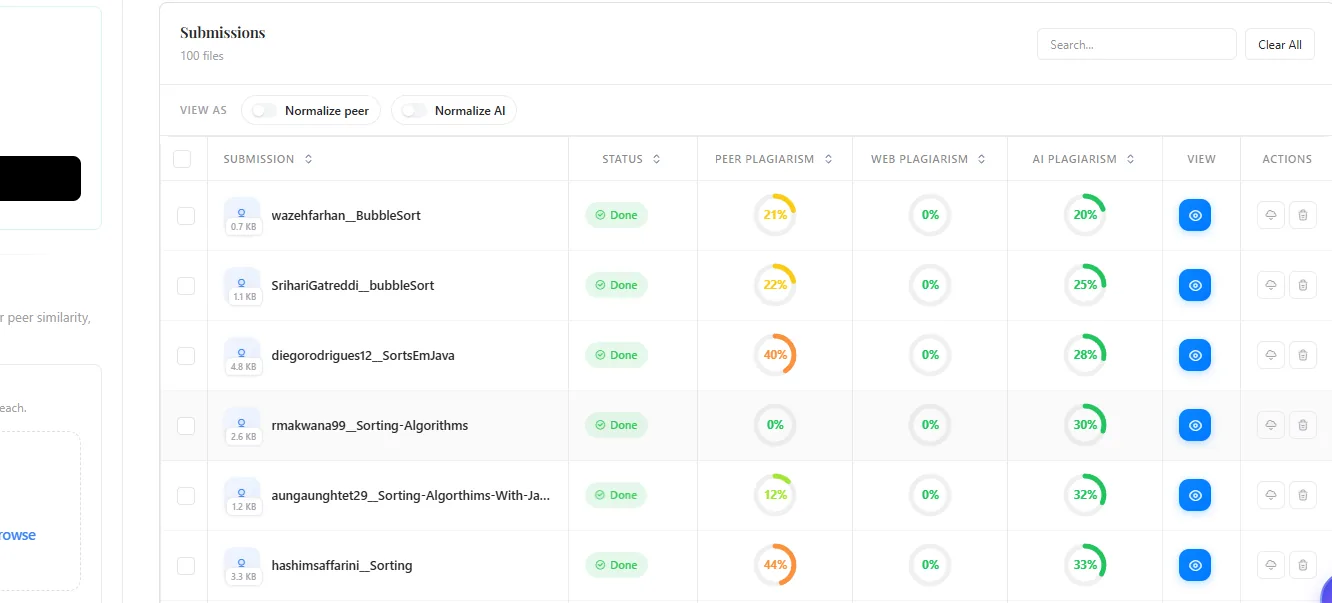
Submissions dashboard listing student files with peer, web, and AI plagiarism scores per submission
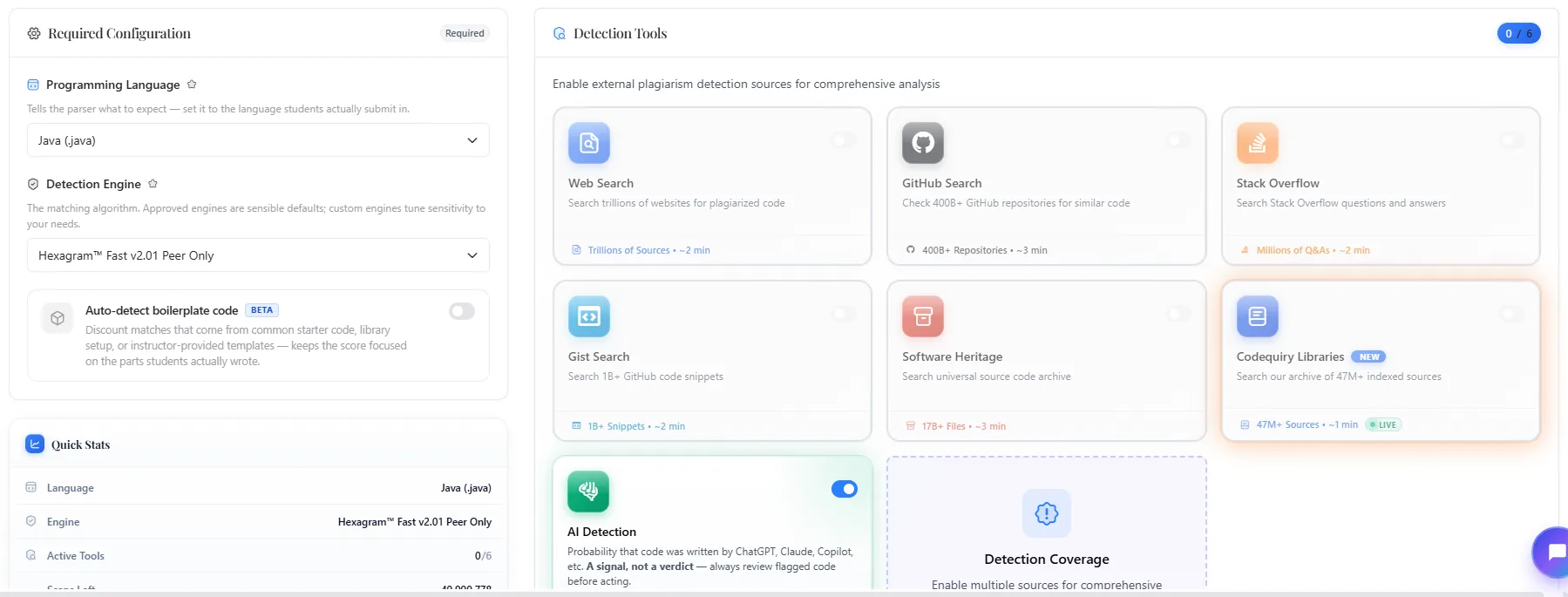
Detection tools configuration with web, GitHub, Stack Overflow, Gist, Software Heritage, and AI detection sources
Run your first check in minutes — 1-day free trial. Start checking code
Line-by-line detection

Ensure Original
Source Code

Codequiry inspects each line of submitted code and surfaces exact matches across the open web, public repositories, AI-generated output, and prior peer submissions — in seconds.

cs-105 · lab_07 / wordle_solver.py 3 high-risk matches
1# CS-105 Lab 7 jpatel42
2import random # for picking starter words later
3 
4WORDS = open("words.txt").read().split()
5# print(len(WORDS)) # debug — should be ~12k
6 
7def score_guess(guess, answer):Lines 7–17 · Chegg · 97%
8 feedback = ["miss"] * 5
9 answer_chars = list(answer)
10 for i in range(5):
11 if guess[i] == answer[i]:
12 feedback[i] = "hit"
13 answer_chars[i] = None
14 for i in range(5):
15 if feedback[i] == "miss" and guess[i] in answer_chars:
16 feedback[i] = "close"
17 answer_chars.remove(guess[i])
18 return feedback
19 
20# TODO: cache this between rounds??
21def filter_words(words, guess, feedback):Lines 21–25 · GitHub · 94%
22 return [w for w in words if score_guess(guess, w) == feedback]
23 
24def letter_frequency(words):
25 counts = {}
28 return counts
29 
30from typing import List, DictLines 30–41 · AI-Generated · 89%
31 
32def best_next_guess(candidates: List[str]) -> str:
33 """Select the most informative next guess.
34 Args:
35 candidates: A list of remaining valid 5-letter words.
36 Returns:
37 The candidate that maximizes letter-frequency coverage.
38 """
39 freq: Dict[str, int] = letter_frequency(candidates)
40 score = lambda w: sum(freq.get(c, 0) for c in set(w))
41 return max(candidates, key=score)
Get Started Free Plans starting at $29/mo
How It Works

Check Code for Plagiarism
and Similarity

Codequiry empowers educators by ensuring that students are learning and not just copying code.

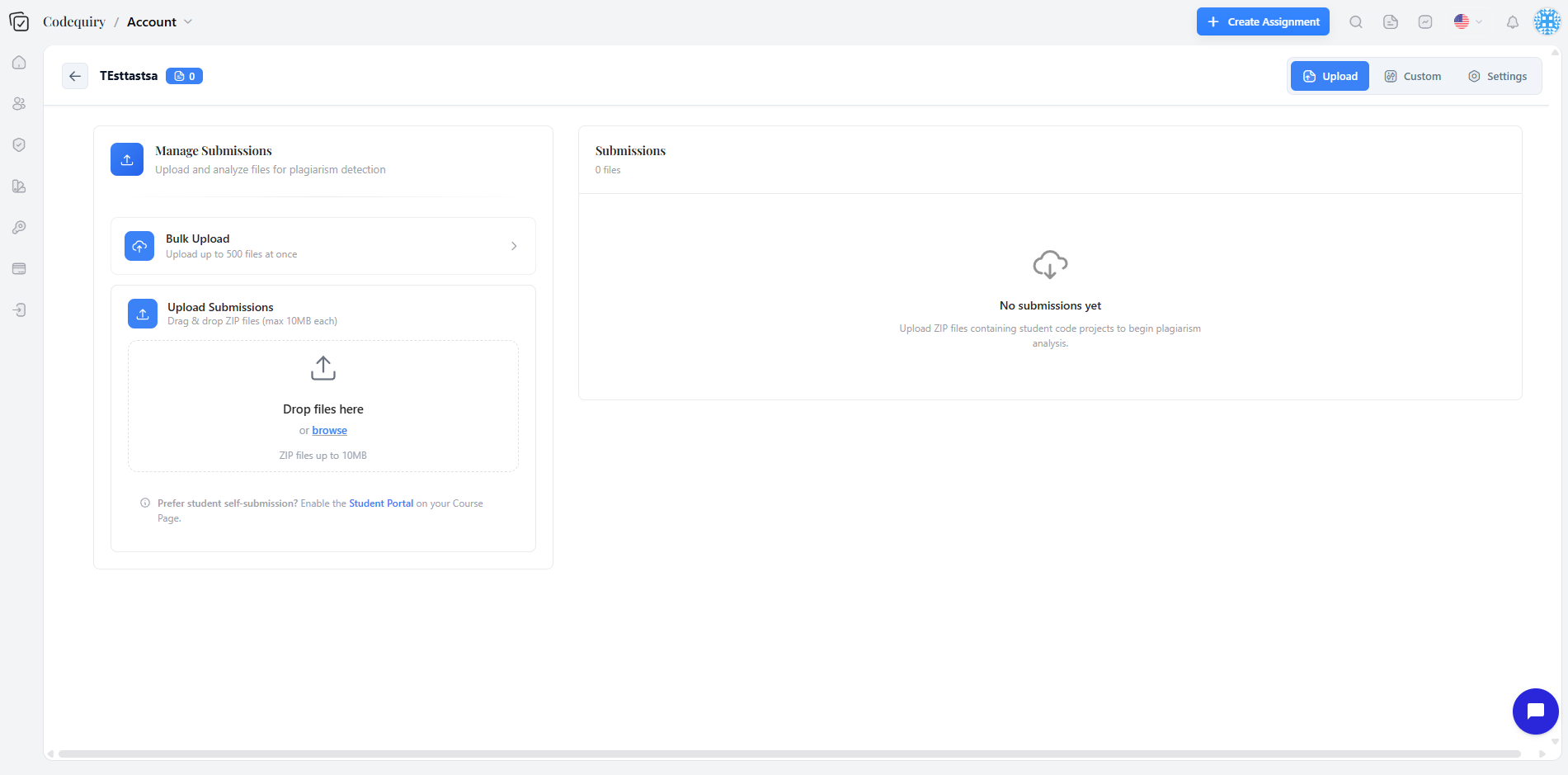
Upload interface
01

Upload & Start Checks

Specify the programming language, drag and drop submissions, and run different types of tests—peer, database, or web check.

Learn about our tests
Results overview
02

Results in Seconds

See realtime checking progress and get results instantly. Codequiry's average time from starting checks to results is 12 seconds.

Learn about results
Detailed insights
03

Detailed Insights

View cluster graphs, match tables, and histograms. Inspect individual submissions with highlighted matches and side-by-side comparisons.

Get Started Free
Detection Engines

Built specifically for
source code

Codequiry's plagiarism engine runs against both internal and external sources to detect all forms of unoriginal code—built with the advanced requirements for detecting source code similarity.

20B+ Lines of Code
100M+ Sources
12s Avg. Time
Get Started Free
Internal

Peer Check

The most comprehensive test for checking similarity within a group of submissions. Compares unique fingerprints, detecting logical similarities and code collusion.

Cross-submission analysis Fingerprint matching Collusion detection
External

Web Check

Compares code to over 100 million sources from GitHub, GitLab, Stack Overflow, and 2 billion+ code instances on the web.

GitHub & GitLab scanning 2B+ code instances Side-by-side matches
New Introducing Our Most Advanced Engine

Zeus AST-Powered

Our first in-house detection model, built from the ground up using AST tokenization. More accurate and effective than legacy engines like MOSS or JPlag.

45 Seconds

What takes MOSS 45 minutes, Zeus does in under a minute. No more waiting.

60x faster than MOSS

Universal Intelligence

Every programming language, instantly—no configuration needed

Cross-Language Detection

Python from Java? JavaScript from C++? We catch it.

Obfuscation-Proof

Renamed variables? Shuffled functions? Still caught.

Logic-Aware

Detects restructured algorithms others miss

2% False Positive Rate

Industry-lowest. Flag real cheaters, not innocent students.

12x more accurate
All engines included
Zeus Hyper MOSS JPlag Dolos

Performance Comparison

100 student submissions. Same test. Different engines.

Zeus Hyper
~45 sec
Winner
JPlag
~6 min
8x slower
Dolos
~15 min
20x slower
MOSS
~45 min
60x slower

*Benchmarked against 100 real student submissions across multiple languages.

Four Detection Layers

Complete protection,
stacked in your favor

Four specialized engines work in parallel. Together they catch what no single tool can.

01

Peer Comparison

Compares all submissions using AST-level tokenization. Catches renamed variables and reordered functions.

AST analysis 500+ files/min
02

Web Source Check

Checks against GitHub, Stack Overflow, Chegg, and billions of indexed sources with direct URL tracking.

1T+ sources Source URLs
03

AI Code Detection

Identifies patterns from ChatGPT, Claude, Copilot. Updated weekly as AI models evolve.

ChatGPT Copilot
04

AI Analysis Engine

Synthesizes findings, scores risk, presents clear evidence. You make the final call.

Risk scoring Evidence summary
You decide—we provide the evidence
Powerful Features

Everything you need to protect
academic integrity

Purpose-built for computer science education. Not a text plagiarism tool with code features bolted on.

Side-by-Side Comparison

Line-by-line diff viewer with syntax highlighting, similarity scoring, and one-click navigation between matched sections.

Syntax highlighting Click-to-navigate Export to PDF

Visual Clustering

Interactive 2D diagrams revealing collaboration patterns at a glance.

AI Code Detection

Identifies ChatGPT, Copilot patterns. Updated weekly.

10-Minute Results

Process 500 submissions in under 10 minutes. No waiting.

Source URL Tracking

Direct links to where the code was found. Complete transparency.

Public API

Powerful REST API for custom integrations. Build your own workflows and automate code checking at scale.

REST API access Webhooks Full documentation
Detailed Results

The results speak
for themselves

Extremely detailed reports let you investigate any suspicious cases of code plagiarism.

20B+ Lines of Code

Comprehensive scanning across web, repositories, and code sources.

Similarity Scoring

Precise algorithms calculate scores with industry-leading accuracy.

2D Clustering Graph

See clusters of similar submissions—spot patterns instantly.

Matched Snippets

Side-by-side comparison with syntax highlighting.

Source Pie Chart

Visual breakdown showing percentage distribution of sources.

Base Code Detection

Automatically recognizes starter code to eliminate false positives.

Web Source Links

Direct links to GitHub, Stack Overflow where code was found.

Confidence Score

AI-powered originality score for informed decisions.

Why Codequiry

Why top universities
switched to Codequiry

Feature
Codequiry
MOSS
Dolos
Peer-to-Peer Comparison Compare student submissions
Web Source Scanning Check against GitHub, Stack Overflow
AI Code Detection ChatGPT, Copilot detection
ASI AI Comparison Engine AST-based analysis for accurate comparisons (MOSS lacks this)
Modern UI & UX Intuitive, visual interface
60+ Languages Python, Java, C++, JavaScript, etc.
~24
~15
Cloud-Based No installation required
Self-host
Testimonials

Why educators
love us

Trusted by 500+ institutions worldwide

"The rise of AI-generated code has made verifying student mastery a critical challenge. Codequiry is now essential for upholding our academic standards and ensuring every submission represents original effort."

Stanford University Professor

"Codequiry actually works—detecting AI-generated code and web plagiarism that outdated tools miss. We finally have real enforcement backing our academic integrity policies."

Georgia Tech Lecturer

"We found a 99% match between a student and a Chegg solution. I can't believe CS departments are missing this."

University of Toronto Professor

"We like that it includes MOSS. But we don't really use it, the Zeus Hyper detection is so much better."

UC Berkeley Lecturer

"Used MOSS for years but it couldn't catch web plagiarism at all. Students figured that out fast."

Carnegie Mellon Professor

"Love that I can exclude my starter code. Used to get tons of false matches because everyone had the same template."

University of Michigan Lecturer

"Been using it 2 years now. Solid. Does what it says."

Arizona State Instructor
60+ Languages

Every language.
No configuration.

From Python to COBOL, Codequiry understands them all. Just upload and go.

Python JavaScript Java C++ C# PHP C TypeScript Swift Kotlin Rust Go Ruby SQL R MATLAB Haskell Scala Dart Elixir Assembly Objective-C Julia Groovy +24 more
Beyond MOSS

Everything MOSS does.
Plus everything it can't.

MOSS pioneered code similarity detection. Codequiry runs it as one of several engines, then adds web-wide matching, AI detection, and 65+ languages on top.

MOSS alone The 1994 academic standard
  • Compares only the files you upload, no web, GitHub, or Stack Overflow
  • No AI-written code detection
  • About 24 supported languages
  • Script submission and dated results pages
  • Rate-limited, academic-only, unsupported
Recommended
Codequiry The modern detection platform
  • Matches against 2 trillion+ web sources and every peer submission
  • Built-in AI code detection (ChatGPT, Claude, Copilot)
  • 65+ programming languages
  • Instant dashboard with side-by-side highlighted matches
  • Includes the MOSS engine, plus Hexagram, Dolos & JPlag
Hexagram™ v2.0.1 Our flagship engine. Structural, AST-based analysis flags refactored, renamed, and reordered code that slips past MOSS's token fingerprinting.
Zeus™ Detection Suite Deep multi-signal comparison plus AI-written-code detection, an entire layer of analysis MOSS does not have.

Codequiry includes MOSS, and goes far beyond it with the Hexagram™ and Zeus™ engines.

Code plagiarism & AI detection

Frequently asked questions

How Codequiry works as a code plagiarism checker, a programming plagiarism checker for 65+ languages, and an AI code detector, plus how it compares to MOSS.

What is the best code plagiarism checker for programming assignments?

Codequiry is a purpose-built code plagiarism checker for source code, not repurposed text-matching software. It compares every submission against your peer group and 2 trillion+ web sources (including GitHub and Stack Overflow), understands code structure across 65+ programming languages, and runs proven engines like MOSS, JPlag, and Dolos, plus its own Hexagram and Zeus engines, in a single evidence-rich report.

Does Codequiry work as a programming plagiarism checker for any language?

Yes. Codequiry is a programming plagiarism checker that supports 65+ programming languages, including Python, Java, C++, JavaScript, C#, Go, and Rust, with no configuration. It detects copied and refactored code even after variable renaming, reordering, or comment changes, comparing submissions to one another and to billions of public repositories.

Is Codequiry an AI code detector as well as a plagiarism checker?

Yes. Codequiry pairs its source code plagiarism checker with a built-in AI code detector that flags code generated by ChatGPT, GitHub Copilot, Claude, and Gemini across 65+ languages. One report covers both copied code and AI-written code, so you can catch academic integrity issues that text-only and MOSS-style tools miss entirely.

Is Codequiry a good alternative to MOSS?

Yes. Codequiry is a modern MOSS alternative that includes the MOSS engine and adds web-wide source matching across 2 trillion+ sources (including GitHub and Stack Overflow), AI-written code detection, and support for 65+ programming languages, capabilities MOSS does not offer on its own.

What engines does Codequiry use to detect source code plagiarism?

Codequiry runs several detection engines in a single report: its flagship Hexagram engine, the Zeus Detection Suite, MOSS, Dolos, and JPlag. Hexagram and Zeus add structural, AST-based and AI analysis that goes beyond MOSS's token fingerprinting.

Can MOSS detect AI-written code from ChatGPT or Copilot?

No. MOSS only measures similarity between the files you submit and has no AI detection. Codequiry includes a dedicated AI code detector that flags code generated by ChatGPT, Claude, and GitHub Copilot.

Does Codequiry include MOSS?

Yes. MOSS is one of Codequiry's built-in detection engines, available on the Advanced plan and above, so a single Codequiry report combines MOSS-style winnowing with the Hexagram and Zeus engines.

How many programming languages does Codequiry support compared to MOSS?

Codequiry supports 65+ programming languages including Python, Java, C++, JavaScript, Go, and Rust with no configuration, while MOSS supports about 24 languages.

How is Hexagram better than MOSS for code plagiarism detection?

MOSS relies on token-based winnowing, which can be evaded by renaming variables or reordering code. Codequiry's Hexagram engine adds structural, AST-based analysis that detects refactored and obfuscated code, and the Zeus suite adds AI-written-code detection that MOSS lacks entirely.

Start protecting academic integrity today

Code with Integrity

The most effective source code plagiarism detection. Trusted by 500+ institutions worldwide.

Plans from $29 · Enterprise pricing available

Book a Call

Let's discuss how Codequiry can help your institution

1
2
3

Select a Date

Loading...

Your Information

We'll send your confirmation to this email

Helps us verify educator status

Required for call confirmation

Tell Us More

Required - This helps us prepare for our conversation

Booking your call...

Call Booked Successfully!

Your consultation is confirmed. We've sent a confirmation email with all the details!

📅 SCHEDULED FOR
🕐 Pacific Time (PST/PDT) • 30 minutes
💡 Get Ready:
Sign up to explore Codequiry before your call!