Plagiarism checker for programming assignments
Programming assignments get copied in ways an essay checker cannot see: from a classmate, from last term, from GitHub, or from ChatGPT. Codequiry checks every submission against all four, leaves the starter code out, and shows you the matching lines.
2-day free trial. Checks every file against classmates, the web and AI, in 65+ languages.
account.cppaccount.cppA solution handed down from a student who took the course before, with the names changed (highlighted). Comparing only this term's class would miss it.
Used in programming courses at





Why code needs its own checker
A text checker like Turnitin compares words. In code, the words are the part students change first: rename the variables, rewrite the comments, reformat, and the text no longer matches while the program is the same.
Code checkers compare structure instead, the order of operations and control flow that stay put when the names change. Assignments bring their own problems on top of that:
- Starter code is in every submission and should never count as a match.
- Small solutions look alike. Ten lines that sort a list will resemble each other whoever wrote them.
- Copies come from outside the class: last term, GitHub, Stack Overflow, and AI tools.
What gets checked
Classmates
Every submission against every other one in the assignment, including across sections.
Past terms
Earlier submissions to the same course, so a solution handed down still matches.
The web
GitHub, GitHub Gists, Stack Overflow, Software Heritage and the indexed web.
AI-written code
A detector trained on ChatGPT, Claude, Gemini and Copilot output, with its reasons shown. How it works.
Built for how assignments work
- Starter code is left out. Upload it with the assignment and matches against it are removed.
- Boilerplate is labeled. Matches on common code, like imports and standard patterns, are marked so you can tell them apart from real copying.
- Whole projects work. Each student's submission is one ZIP with as many files and folders as it needs. Jupyter notebooks are supported.
- 65+ languages, and a solution translated from one language to another can still match.
- Submissions come in the way you collect them: a ZIP upload, your LMS including Canvas, the API, or Window, a student IDE that records pastes as they happen.
From upload to evidence
- Create the assignment, pick the language and add any starter code.
- Add the submissions. Upload a ZIP of the class or pull them from your LMS.
- Run the check. Results come back in minutes for a typical class.
- Sort by score. Each student has a peer, web and AI score, so the handful worth a closer look are at the top.
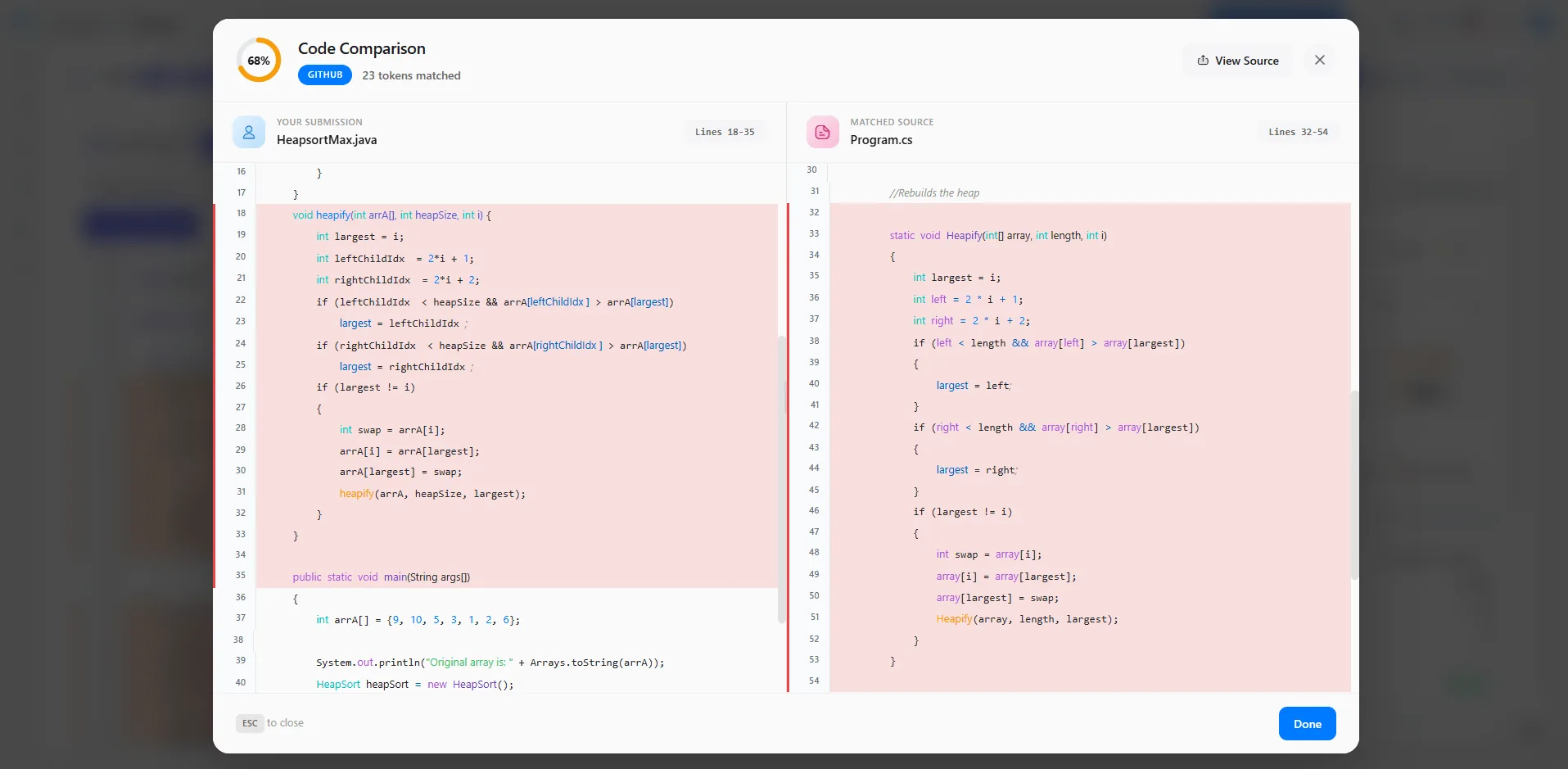
- Open the match. The two files sit side by side with the shared lines marked, ready to export as a report.
Check your next assignment
Upload the class as a ZIP. Results come back in minutes.
2-day free trial
What instructors say
“Teaching over 500 students per term, we faced a critical challenge: detecting code copied from ChatGPT and online sources without viable tools. Codequiry enables us to batch-process entire cohorts efficiently.”
“Codequiry actually works, detecting AI-generated code and web plagiarism that outdated tools miss. We finally have real enforcement backing our academic integrity policies.”
Frequently asked questions
What is a programming assignment plagiarism checker?
A tool that compares students' source code, rather than prose, to find copied, shared or AI-generated work. It reads program structure, so renamed variables, new comments and reformatting do not hide a copy.
Can Turnitin check programming assignments?
Turnitin is built for essays and compares text. Code needs a checker that compares structure, handles starter code, and knows where code gets copied from, such as GitHub and Stack Overflow.
How do I stop starter code from being flagged?
Upload the starter code with the assignment. Code every student was given is then left out of the matches, so only what students wrote themselves is compared.
Can it check multi-file projects and Jupyter notebooks?
Yes. Upload each student's project as one ZIP, with as many files and folders as it needs. Jupyter notebooks are supported too.
Does it compare with previous terms?
Yes. Submissions can be checked against earlier terms of the same course, which catches a solution handed down from a student who took it before.
Which languages are supported?
More than 65, including Python, Java, C, C++, C#, JavaScript, TypeScript, Go, Rust, Kotlin, Swift, PHP, Ruby, R, MATLAB, SQL and assembly.
Can it detect code written by ChatGPT?
Yes. Every submission can also be checked by an AI code detector trained on output from ChatGPT, Claude, Gemini and Copilot. It reports a probability and the reasons behind it, for a person to weigh.
Check this week's assignment
Every submission against classmates, past terms, the web and AI, with the lines side by side.
Start free trial2-day free trial
Just one assignment? Run a single check