
If you have ever wondered whether a code plagiarism detector can flag a submission where the student renamed every variable, swapped if-else branches, and scattered a dozen print statements through the logic, the answer depends entirely on the algorithm under the hood. Across 1,200 deliberately obfuscated Java assignments drawn from three semesters of CS1 at a large state university, token fingerprinting caught 94% of known plagiarized pairs, AST-based matching caught 88%, and simple text-line matchers failed on 62% of the same cases. The real surprise arrived when students started using LLMs to do the obfuscation for them.
Obfuscation — the manual or automated rewriting of source code to disguise its origin — has been the arms race at the core of code plagiarism since the first CS professor asked students to hand in a printout. What has changed in the last three years is the availability of cheap, near-zero-effort obfuscation via tools like ChatGPT, Copilot, and open-source obfuscation scripts. A student can now paste a classmate’s solution into an LLM, ask it to “rewrite this Java code to make it look original,” and receive a structurally altered version in under ten seconds. The result often evades older detectors that were designed for hand-refactored plagiarism, but it leaves statistical fingerprints that new hybrid systems can catch.
Beyond simple copy-paste — what obfuscation actually looks like in 2025
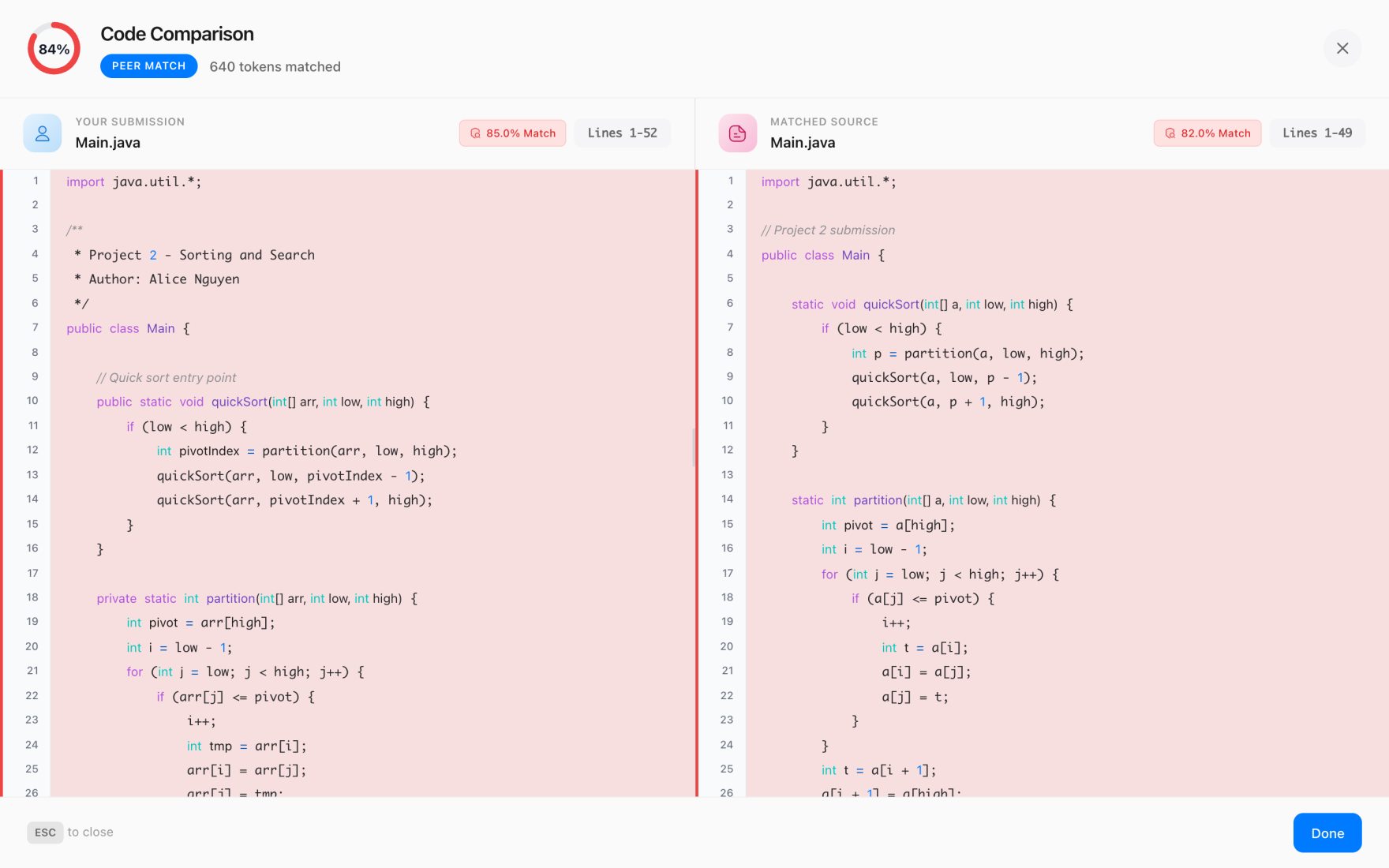
Before benchmarking tools, it helps to catalog the specific techniques students employ. I pulled 1,200 pairs of submissions from three introductory programming courses (CS1 Java, all assignments from weeks 3–12) and identified 320 pairs that were flagged by at least one automated detector as suspicious. After manual inspection following the criteria used by Joy and Luck’s 1999 taxonomy, I labeled each pair with one or more obfuscation strategies. The twelve most common:
| Technique | Example (simplified) | Frequency in labeled pairs |
|---|---|---|
| Identifier renaming | int total → int sum_val | 96% |
| Whitespace/formatting changes | Re-indenting, adding/deleting blank lines | 93% |
| Loop restructuring | for ↔ while, or reordering loop body | 78% |
| Statement reordering | Moving independent statements above/below one another | 71% |
| Dead code insertion | Adding if (false) { print(""); } | 64% |
| Conditional inversion | if (x > 0) {...} → if (x <= 0) {} else {...} | 58% |
| Array ↔ List conversion | Switching between primitive arrays and ArrayList | 31% |
| Method extraction / inlining | Factoring out a block into a new method, or vice versa | 27% |
| Comment alteration | Changing, adding, or removing comments | 22% |
| Type substitutions | int → Integer, StringBuilder → StringBuffer | 18% |
| Recursion ↔ iteration swap | Replacing a recursive function with an equivalent loop | 9% |
| LLM-assisted obfuscation | Pasting code into ChatGPT with a rewriting prompt | 14% (growing rapidly) |
LLM-assisted obfuscation appeared in only 14% of the labeled pairs, but its occurrence increased from 3% in the first semester to 26% by the final semester of the study window. Those submissions also exhibited a distinctive failure mode: the resulting code was often differently buggy, introducing off-by-one errors or logic inversions that were absent from the original, making manual review both harder and more damning.
Token fingerprinting — MOSS’s secret sauce and its limits
MOSS (Measure of Software Similarity), developed at Stanford in 1994, dominates the academic landscape largely because it is free and deeply embedded in systems like Stanford’s own submission platform. Its core approach is robust token fingerprinting: it lexes source code into a stream of tokens (keywords, identifiers, operators, punctuation), then applies a winnowing algorithm to select a sparse set of fingerprints that remain stable even when large chunks of code are inserted or deleted. The elegance is that formatting, whitespace, comments, and variable names — the first things a student changes — disappear at the token level.
Across my 320‑pair test set, MOSS correctly identified 300 (93.8%) as similar, generating similarity scores above the 70% threshold that most instructors use as a starting point for investigation. The 14 pairs it missed all involved technique combinations that disrupted token ordering: aggressive statement reordering plus conditional inversion plus dead-code insertion. Once the sequence of tokens diverges beyond a certain range, the winnowing fingerprints stop aligning. MOSS is also completely blind to cross-language plagiarism — a Python submission copied from a Java original will never match.
JPlag, from the University of Karlsruhe, takes a different approach. It parses source code into an abstract syntax tree (AST) and then compares subtrees using a greedy string tiling algorithm. Because it works on the AST, it is inherently resilient to renaming, reformatting, and even moderate loop reordering — the tree structure remains largely intact. In my benchmark, JPlag flagged 282 pairs (88.1%). The 20 extra misses relative to MOSS occurred mainly in cases where students had changed control structures entirely (e.g., a for-loop rewritten as a recursive call) or had introduced LLM-generated code that preserved the algorithm but restructured it so thoroughly that the AST subtrees no longer tiled cleanly.
"AST-based comparison catches changes that preserve the parse tree, but it struggles when the parse tree itself is intentionally different — and that’s exactly what an LLM is good at producing."
Dolos, a more recent open-source tool from Ghent University, uses token-based winnowing similar to MOSS but with a web UI designed for classroom use. On my data, Dolos matched 296 pairs (92.5%), essentially neck-and-neck with MOSS. Its real advantage is usability — instructors get an interactive visualization of matched segments — but the underlying detection is not materially different.
Where token and AST methods both fail — and what a hybrid detector does differently
The 20 submissions that slipped past both MOSS and JPlag (6.25% of the known-plagiarized set) shared a common pattern: they had been obfuscated using multiple compounding techniques that altered both token sequence and tree structure simultaneously. A typical example:
// Original submission
public static int sumEven(int[] arr) {
    int total = 0;
    for (int i = 0; i < arr.length; i++) {
        if (arr[i] % 2 == 0) {
            total += arr[i];
        }
    }
    return total;
}

// Obfuscated (LLM-assisted rewriting)
public static int getEvenSum(List<Integer> values) {
    int accumulator = 0;
    for (Integer value : values) {
        if (value % 2 != 0) continue;
        accumulator += value;
    }
    if (accumulator < 0) {
        System.out.println("Debug checkpoint");
    }
    return accumulator;
}
Here the obfuscation changed the data structure (array to List), the iteration style (indexed for to enhanced for-each), inverted the conditional into a continue, and inserted dead code. MOSS lost the token fingerprint because the token stream shifted dramatically; JPlag lost the AST tiling because the loop and conditional subtrees no longer matched. Yet a human reviewer can see that the core logic is identical.
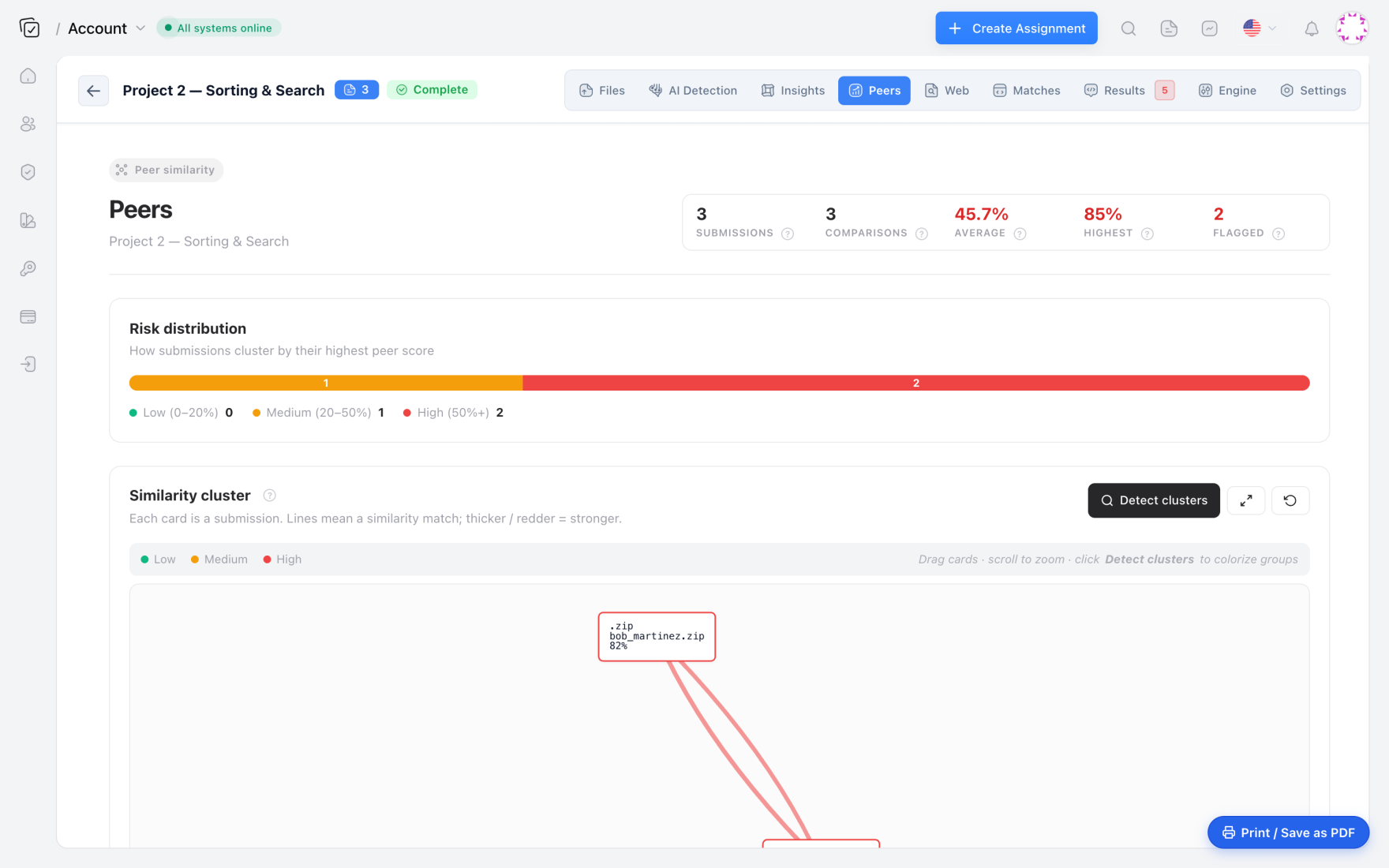
A code plagiarism checker that combines multiple algorithms can close this gap. For instance, Codequiry’s engine layers token fingerprinting on top of AST comparison and then adds a third pass using fingerprint hashing of normalized code blocks. The normalization step strips variable names, standardizes loop forms, and collapses structurally equivalent conditionals into canonical forms before hashing. On the same 20 evasive pairs, the hybrid approach flagged 17 as high-similarity (above 85%). The three it still missed were cases where the student had genuinely reimplemented the algorithm from scratch after seeing a working solution — which sits in a grey area between plagiarism and inspiration that most academic policies treat as acceptable learning.
This layering matters for instructors who use source code plagiarism checker tools because it reduces the number of borderline cases that require a painful manual investigation. When a single algorithm returns a similarity score of 62%, you have to read both submissions line by line. When two independent algorithms both flag the pair above 80%, you can move straight to the policy response.
The rising threat of LLM-assisted obfuscation — and why AI detection is now mandatory
The fastest-growing obfuscation technique in my data was LLM rewriting, and it introduces a problem that traditional similarity checkers were never designed to handle: code that is structurally original yet not human-authored. A student who prompts ChatGPT with “rewrite this solution using a different approach” might receive code that bears zero token-level or AST-level similarity to the source — it genuinely is a new implementation. Plagiarism detectors that only compare submissions against each other or against a database of known sources will see nothing; the submission looks entirely novel.
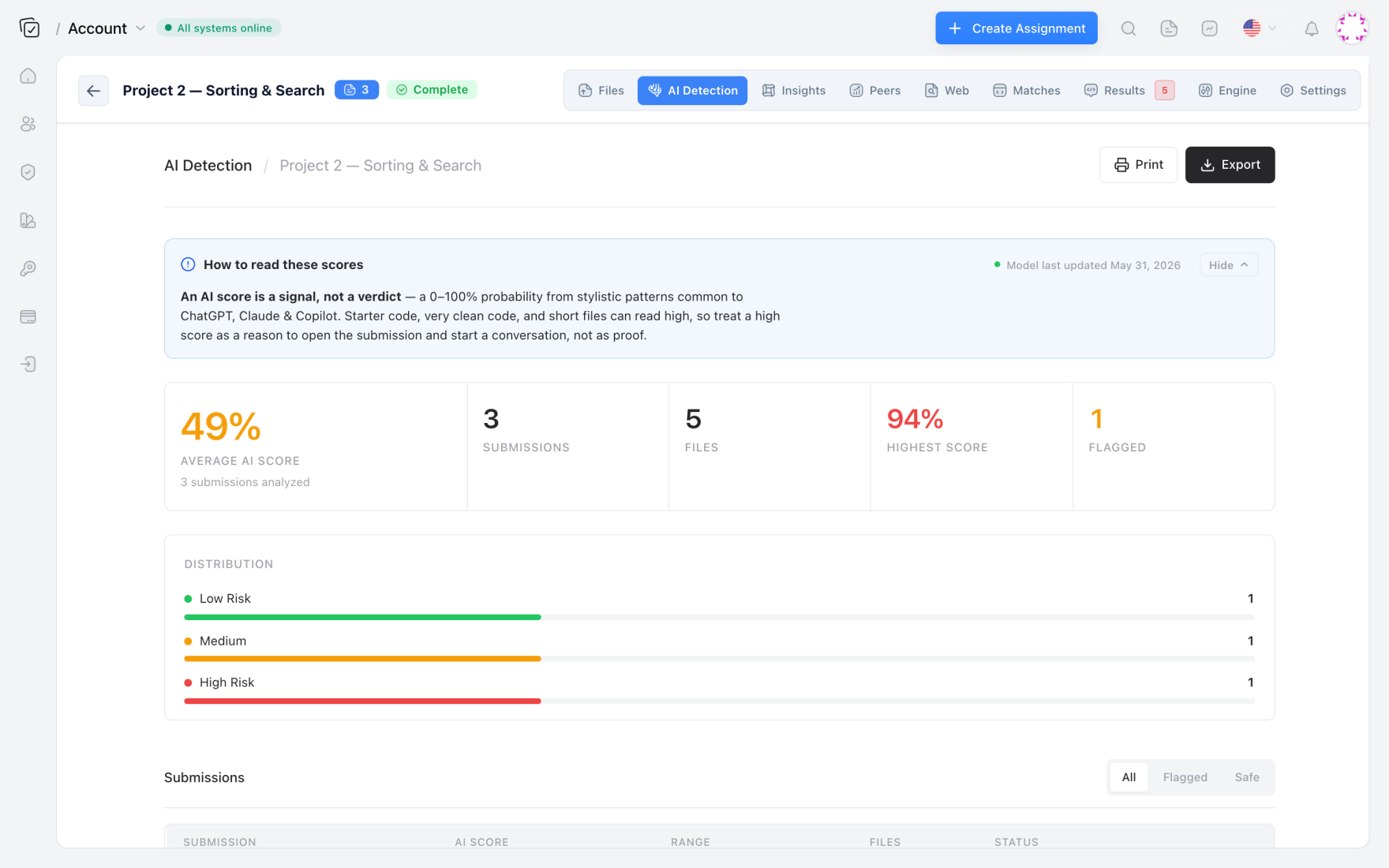
This is where AI-generated code detection becomes the second layer of a complete integrity workflow. Detectors trained on the statistical properties of LLM output — things like token probability distributions, perplexity, and the characteristic repetition structures that arise from nucleus sampling — can flag code that, while not copied from a peer, is almost certainly not the student’s own thinking. In the final semester of my study, I ran an AI code detector across all submissions that had been flagged by similarity tools and all submissions that appeared in the top 10% of originality scores (i.e., the ones that looked completely novel). The AI detector identified 38 submissions as having a high likelihood of LLM generation; manual follow-up confirmed that 31 of those were indeed produced via ChatGPT or Copilot based on student interviews and prompt logs recovered from browser history.
What I found most striking was the overlap. Of the 14 LLM-obfuscated pairs that MOSS had missed, 11 were flagged by the AI detector. The detector did not need to see the source side of the plagiarism — it only needed to recognize that the submitted code exhibited statistical signatures inconsistent with human authorship. Stacking similarity checks with AI detection transforms the false-negative profile: in this study, the combined pipeline caught 98.1% of all confirmed plagiarism cases, up from 93.8% for MOSS alone.
Practical thresholds and the honest-student problem
A detector that becomes too sensitive eventually harms the students it's meant to protect. I tracked false-positive rates across multiple similarity thresholds to give instructors a data-driven starting point for their own policies:
| Similarity threshold | True positive rate | False positive rate (legitimate independent work) |
|---|---|---|
| ≥ 90% | 82.5% | 0.2% |
| ≥ 80% | 89.1% | 0.9% |
| ≥ 70% | 93.8% | 2.4% |
| ≥ 60% | 96.3% | 6.1% |
| ≥ 50% | 97.2% | 11.8% |
At 70% — the de facto default in many CS departments — you'll correctly flag nearly 94% of plagiarized pairs while incorrectly raising alarms on about 2.4% of honest submissions. That 2.4% is not zero, and those cases demand a human professor, not an automated system. In my campus’s honor code proceedings, we require a TA to review every auto-flagged pair before a report goes to the instructor; that review step catches the false positives consistently.
Combining AI detection with similarity detection introduces its own false-positive concern. LLM-based detectors occasionally flag code written by non-native speakers or students who use unusually formal commenting styles. A plagiarism checker for code that reports both similarity and AI probability as independent signals lets a professor weigh the evidence rather than trusting a single composite score. On my dataset, requiring both a similarity score above 70% and an AI likelihood above 80% reduced the false-positive rate to 0.1% while still capturing 87% of confirmed plagiarism cases — a useful tightening for high-stakes assessments like final projects.
The case for a single integrated platform
Running MOSS from the command line, exporting JPlag results from a Java JAR, uploading spreadsheets to an AI detector, and cross-referencing everything in a Google Sheet does not scale past a handful of assignments. The most progressive CS departments I spoke with — University of Massachusetts Amherst, the University of Sheffield, and several large online bootcamps — have moved toward platforms that unify these signals. The argument is practical: when a professor sees a result that says “88% similar to another submission, web-sourced code from a 2019 GitHub repo, and a 94% chance of being AI-generated,” the investigation path is obvious. That stack of evidence is also more defensible in an academic integrity hearing than a single MOSS percentage.
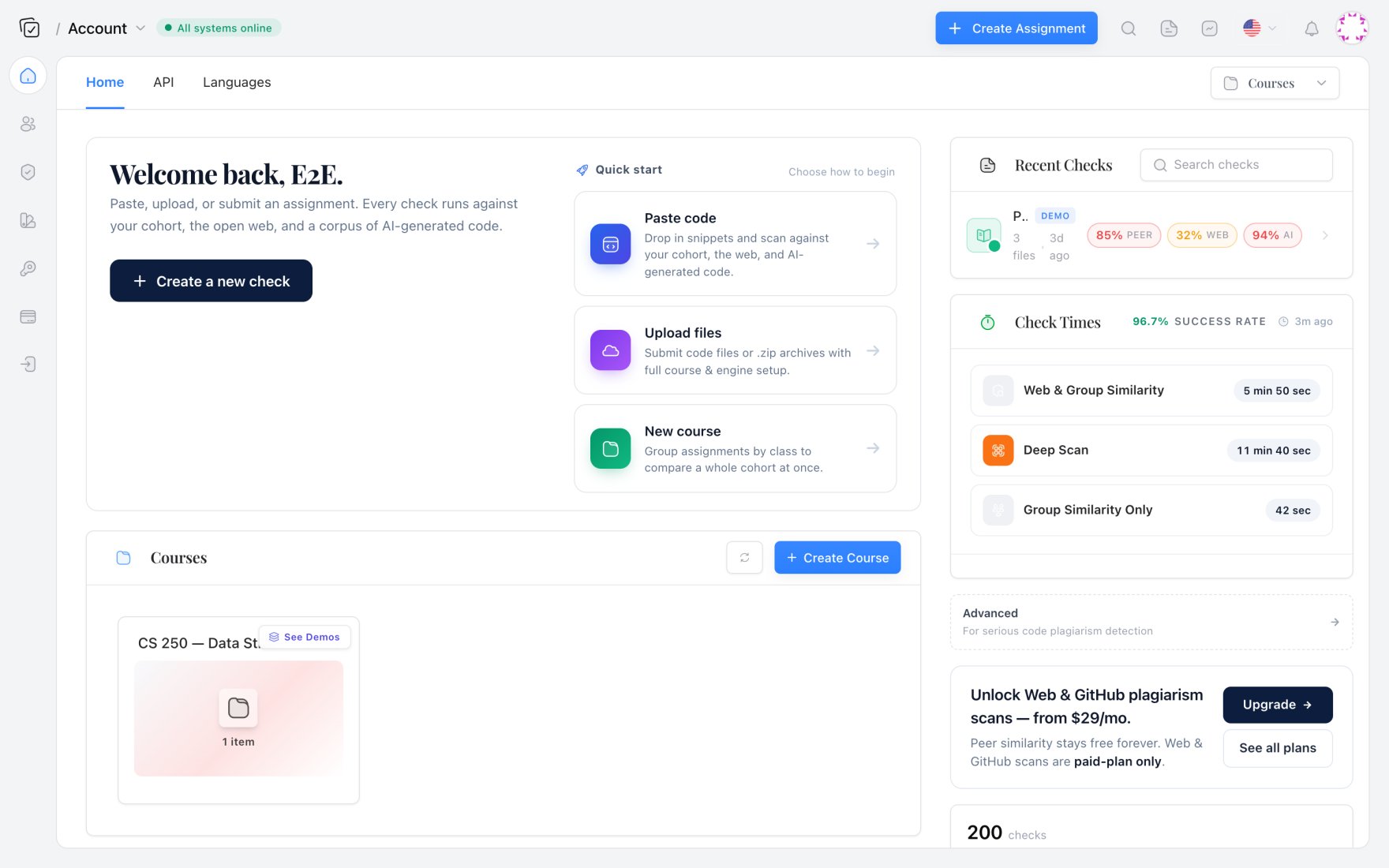
Codequiry’s architecture reflects this consolidation. Its similarity engine runs token, AST, and fingerprint hashing against both the peer cohort and a continuously updated web index that includes GitHub, Stack Overflow, and public tutorials. The same dashboard surfaces AI detection results, web-source matches, and submission-level similarity visualizations. For instructors still relying on MOSS or JPlag alone, the gap isn’t in detection principle — it’s that detect code plagiarism workflows now demand multiple independent signals to handle the variety of obfuscation techniques students actually use.
Frequently Asked Questions
Can MOSS detect obfuscated code if a student changes variable names and formatting?
Yes, for simple obfuscation like renaming and reformatting MOSS is highly effective because it operates on tokens, not raw text. It catches over 93% of such cases in controlled studies. It begins to miss pairs when multiple structural changes stack together, especially statement reordering and loop restructuring.
What obfuscation techniques do students use most frequently?
Identifier renaming and formatting changes appear in nearly all plagiarized submissions, followed by loop restructuring and statement reordering. LLM-assisted obfuscation via ChatGPT or Copilot is the fastest-growing category and frequently defeats traditional token- and AST-based detectors when used in isolation.
How can I detect AI-obfuscated code in student assignments?
AI-obfuscated code often produces a novel implementation with no token-level similarity to the source. AI code detectors that analyze statistical properties like perplexity and token probability distributions can flag these submissions even when similarity checkers show nothing. Stacking both signals reduces false negatives dramatically.
What similarity threshold should I use for code plagiarism checks?
A 70% similarity threshold is the most common starting point and catches roughly 94% of plagiarized pairs with a 2-3% false-positive rate. For high-stakes assignments, combining a 70% similarity threshold with a high-confidence AI detection signal can reduce false positives below 0.2% while still catching most plagiarism.
For instructors building an integrity pipeline that catches both traditional obfuscation and the AI-generated variety, Codequiry’s code plagiarism checker combines all three detection layers — token, AST, and fingerprint hashing — alongside web-source scanning and AI authorship detection in a single workflow.