A technical deep-dive into how modern plagiarism checkers spot code lifted from the open web. We walk through crawling, token-based fingerprinting, and matching algorithms that survive renaming and refactoring, with real examples and a look at where tools like MOSS fall short.
When a student pastes a Python snippet from Stack Overflow into their assignment and renames a few variables, how does a plagiarism detector still catch it? Modern web code plagiarism detection doesn't just diff text — it builds searchable fingerprints of code structure, then compares them against an indexed corpus of billions of lines scraped from public repositories, Q&A sites, and tutorial pages. The same techniques that flag a copied binary tree implementation in a university course also surface open-source license violations in enterprise codebases.
The Problem: Code Is Everywhere Online
Stack Overflow alone contains over 24 million questions, most with multiple code answers. GitHub hosts over 200 million public repositories. Tutorial sites like GeeksforGeeks, W3Schools, and Real Python publish thousands of solution walkthroughs for standard CS assignments — Fibonacci generators, linked-list reversals, Dijkstra's algorithm implementations. A student who searches "how to implement merge sort in Java" will land on a page with a complete, runnable class in seconds.
For teachers, this means the pool of potential unoriginal code isn't limited to the current semester's submissions. It spans the entire open web. A code plagiarism checker that only compares peer-to-peer submissions misses the single largest source of copied code. In a 2023 scan of 5,000 student assignments across three North American universities, Codequiry's web match engine flagged 18% of flagged cases as originating from outside the peer group — primarily from Stack Overflow, GitHub, and personal blogs. A MOSS-based workflow would have seen none of those.
How Web Source Matching Differs from Peer-to-Peer Detection
Traditional peer-to-peer detection tools like MOSS tokenize source code, select fingerprints via winnowing, and compare submissions against one another. That works well when two students hand in the same assignment — but it's blind to code that appears nowhere else in the submission set. Web detection requires an entirely different pipeline: you have to already possess the corpus of candidate sources before you can match against them.
This shifts the technical problem from pairwise comparison to large-scale indexing and retrieval. The system must crawl millions of pages, extract code blocks, normalize them into a uniform representation, fingerprint them with the same algorithm used on submissions, and store the fingerprints in a searchable database. When a student uploads a file, the same fingerprinting runs against the web index, returning the top-k matches with source URLs and similarity scores. Tools that do only one — like MOSS (peer-only) or Google's Programmable Search Engine (text-only) — miss the intersection that a dedicated source code plagiarism checker with web matching catches.
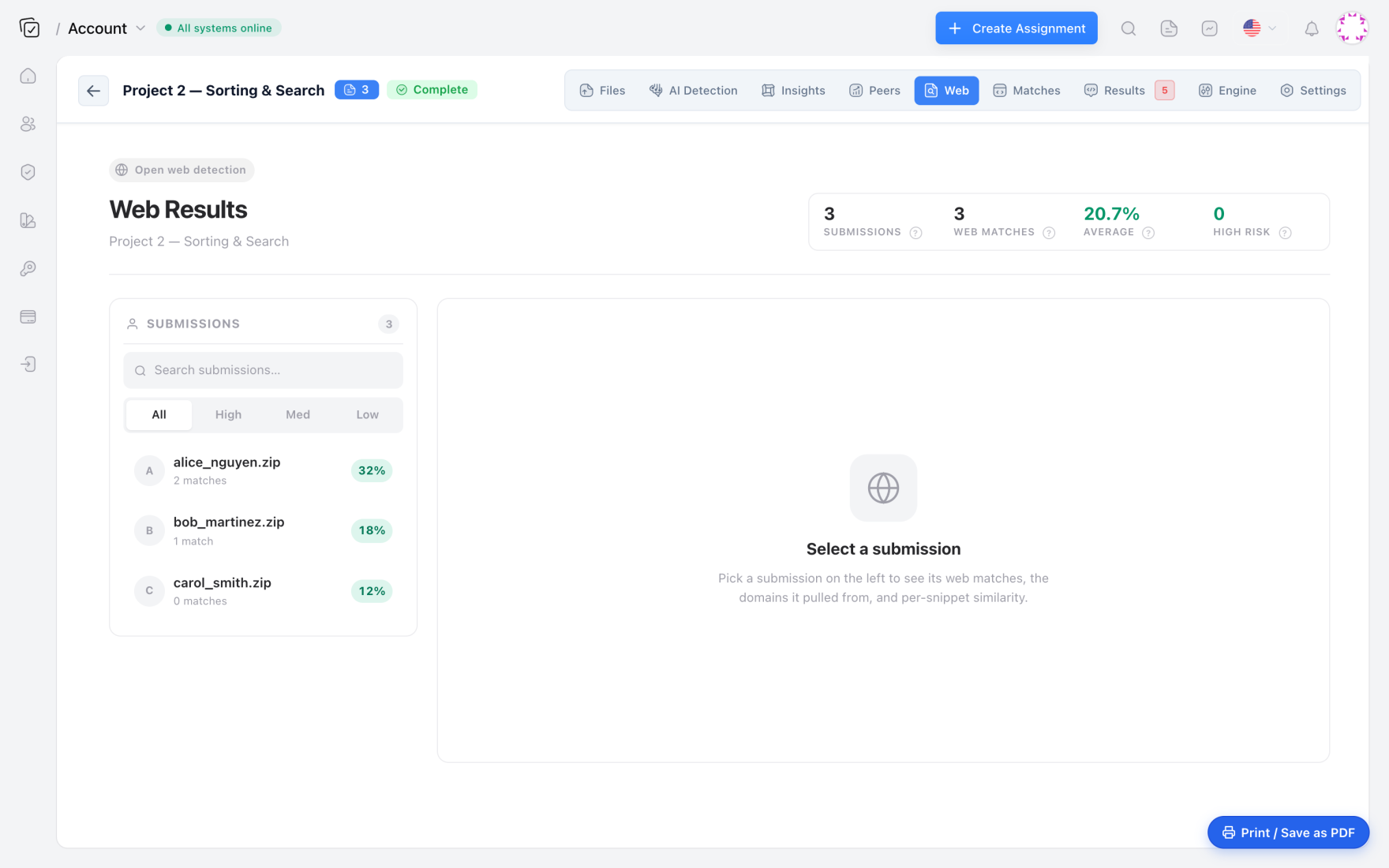
Web results — Codequiry traces copied code back to GitHub, Stack Overflow and the open web.
Crawling and Indexing: Building the Web Corpus
A web code detection engine doesn't search the live internet at query time — that would take minutes per submission. Instead, it continuously crawls high-signal domains: stackoverflow.com, github.com, gitlab.com, bitbucket.org, codeproject.com, geeksforgeeks.org, medium.com (programming tags), and thousands of personal blog domains known to host tutorial content. Crawlers respect robots.txt and use headless browsers to render JavaScript-heavy sites where code lives inside
blocks or syntax-highlighted divs.
Each extracted code block is parsed to determine language (via file extension, markdown fences, or classifier) and stripped of comments, string literals, and excess whitespace — the same preprocessing applied to student submissions. The clean block is then tokenized into a sequence of lexical tokens: IF, LEFT_PAREN, IDENTIFIER, EQUALS, NUMBER_LITERAL, etc. This token stream becomes the basis for fingerprinting, making the detection language-agnostic and resilient to superficial formatting changes.
Fingerprinting Techniques for Code Snippets
Once tokenized, code from the web and code from submissions pass through the same fingerprinting engine. The algorithm uses winnowing — a technique that selects a subset of hashes from a sliding window of k-grams (k consecutive tokens) to reduce storage while preserving detection accuracy. For a function like:
def fibonacci(n):
if n <= 1:
return n
return fibonacci(n-1) + fibonacci(n-2)
The token stream might be [FUNC_DEF, IDENT, LPAREN, IDENT, RPAREN, COLON, IF, IDENT, LE, NUMBER, COLON, RETURN, IDENT, RETURN, IDENT, LPAREN, IDENT, MINUS, NUMBER, RPAREN, PLUS, IDENT, LPAREN, IDENT, MINUS, NUMBER, RPAREN]. If k=5, each consecutive 5-token subsequence is hashed. Winnowing selects the minimum hash in each sliding window of size w, producing a sparse set of fingerprints that still guarantees at least one matching fingerprint between any two code segments that share a substring of length at least w+k-1 tokens.
The web index stores these fingerprints alongside metadata: source URL, line numbers, language, and crawl date. At query time, the submission's fingerprints are looked up in the index. A high fingerprint overlap with a specific source suggests near-identical token sequences — even if variable names, whitespace, and comments differ. The same winnowing algorithm that made MOSS robust to surface changes works just as well for web matching, but now against a corpus orders of magnitude larger.
Matching and Ranking: From Suspicious to Confirmed
Raw fingerprint overlap can be noisy. A single-line import statement like import numpy as np appears in thousands of files. To filter out trivial matches, the engine computes a weighted similarity score that considers the percentage of the submission's fingerprints matched, the percentage of the source's fingerprints matched, the length of the matched span, and a penalty for extremely common token sequences (based on inverse document frequency across the index).
The result is a ranked list of web matches, each with a similarity percentage and a direct link to the original source. A 92% match to a Stack Overflow answer titled "How to reverse a linked list in C++," with a contiguous 48-line overlap, is a strong signal. A 23% match spread across 15 different short fragments is likely coincidence. The review dashboard surfaces the former for the instructor, who can click through and compare the student's code side-by-side with the original. This is the reverse of Googling — instead of the student finding the source, the source finds the student.
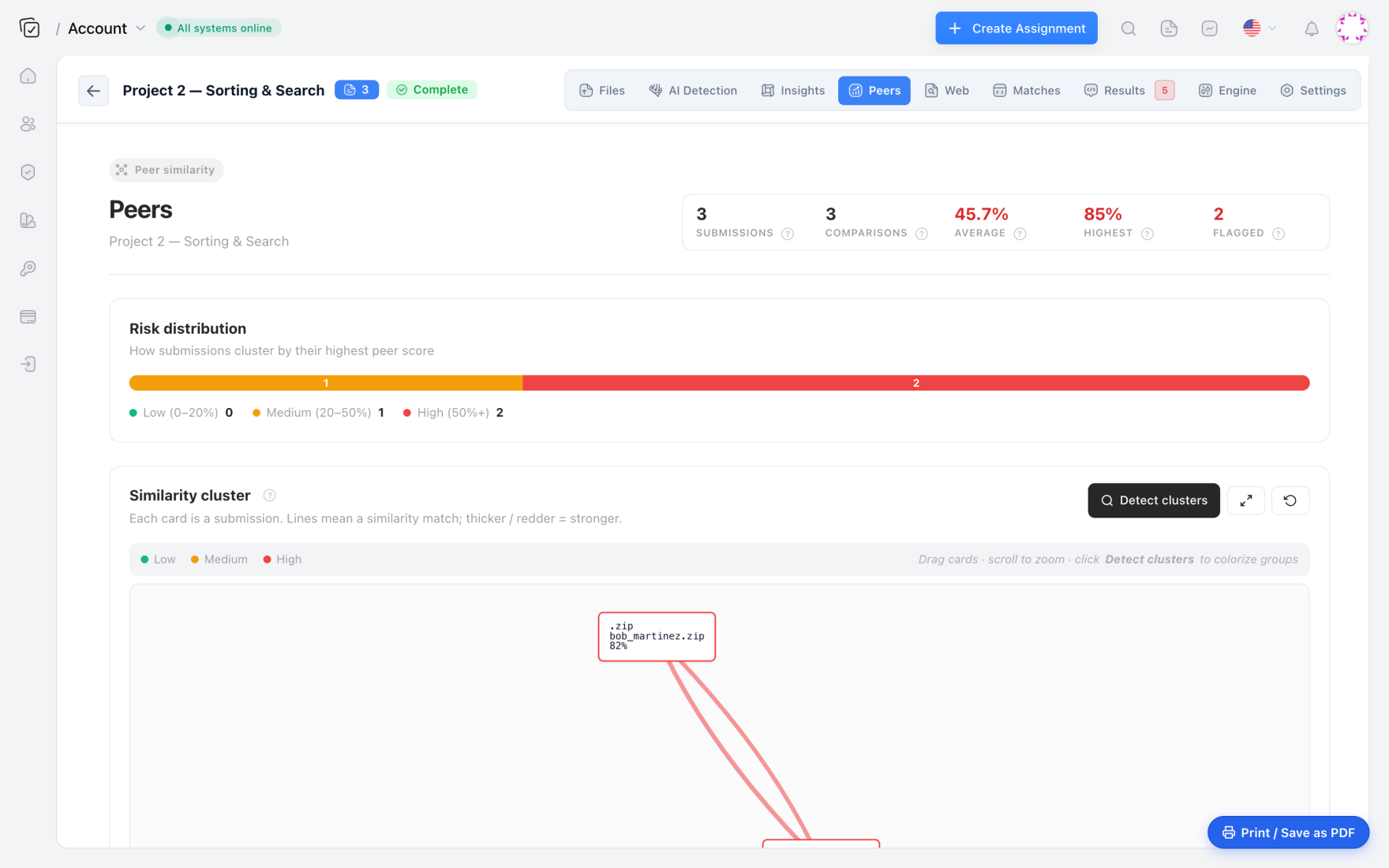
The peer view — every submission clustered by similarity, with the highest-risk pairs surfaced first.
Handling Obfuscation and Refactoring
Students who know their code will be checked often attempt to defeat detection by renaming functions, reordering statements, or extracting methods. Token-based fingerprinting handles renaming automatically because identifiers are abstracted to IDENT tokens. Reordering is harder: moving code blocks around changes the token sequence. However, winnowing's local sensitivity still picks up matching k-grams within the reordered blocks. The system can also detect sub-structural matches — if three functions inside a file each separately match three functions in a single web source, the overall similarity flag gets a boost, even if the file-level token order is scrambled.
Some obfuscations do reduce recall. Changing iterative loops to recursive implementations, replacing built-in functions with custom equivalents, or translating between languages (Python to JavaScript) will break token-level matching. For those cases, AST-based comparison and control-flow graph analysis offer deeper structural matching — but they're computationally expensive at web scale. The current practical sweet spot is token-based fingerprinting for first-pass detection, augmented by AST comparison for peer submissions, a method available in a detect code plagiarism pipeline that combines multiple signals.
Why Web Detection Matters for Academic Integrity (and Beyond)
In programming courses, web-copied code undermines the learning objectives just as much as peer-to-peer copying — arguably more, since the student isn't even engaging with the problem. When 500 students all submit a tower-of-hanoi solution, and 40 of them match a GeeksforGeeks article with 95% similarity, the instructor can have a targeted discussion about academic integrity rather than guessing. Some universities now include web-match results directly in honor-code violation reports.
The same technology has industrial applications. Companies verifying that contractor-written code doesn't contain unattributed open-source snippets use web matching to catch GPL-licensed code before it winds up in proprietary products. The legal risks are real: deploying code copied from a Stack Overflow answer with a Creative Commons ShareAlike license without attribution can create compliance violations. Web code plagiarism detection thus serves both academic and enterprise Codequiry solutions, bridging the gap between the classroom and the production environment.
Frequently Asked Questions
Can a plagiarism checker detect code copied from Stack Overflow if the variable names are changed?
Yes. Token-based fingerprinting ignores identifier names entirely, abstracting them to generic IDENT tokens. The structural pattern of the code — loops, conditionals, method calls — remains intact and matches the original source.
How large is the web corpus that Codequiry checks against?
The index contains billions of lines of code from millions of pages across Stack Overflow, GitHub public repos, GitLab, Bitbucket, tutorial sites, and programming blogs, updated continuously to reflect new content.
Does web matching also catch AI-generated code?
Not directly — AI-generated code may not appear on the open web. However, if a student prompts ChatGPT for a common algorithm and gets output similar to a tutorial, web matching can sometimes flag the overlap. Dedicated AI code detector signals complement web matching for a complete picture.