

By the third week of CS1, the assignments arrive in predictable shape. Most students begin from the same scaffold: a main method, a loop reading standard input, a class definition with getters and setters. When an AI code detector ran across a spring 2024 data structures course at a large public university, it flagged 22 percent of the submissions as likely AI-generated. The instructor, who asked not to be named because the review policy remained under discussion, found the flagging suspicious. Many of the flagged files were structurally near identical to the starter code. Those AI code detector false positives are now a known weakness in tools universities have rushed to adopt, and the problem is most acute on boilerplate-heavy assignments.
Boilerplate code is not a sign of cheating. It is the necessary scaffolding a language demands. In Java, a class with private fields, a constructor, and accessor methods follows a pattern every student sees in the first five weeks. In Python, a script that reads a list and computes an average looks almost identical across hundreds of submissions. When a detector measures predictability, these files score poorly even when a human wrote them line by line.
public class Student {
    private String name;
    private int id;

    public Student(String name, int id) {
        this.name = name;
        this.id = id;
    }

    public String getName() {
        return name;
    }

    public int getId() {
        return id;
    }
}
That file could have come from a student, a course handout, or Codex. A detector that relies on perplexity sees no meaningful difference because the token sequence is extremely likely under any model trained on Java. Lourdes Vega, who teaches computer science at a Florida community college, described the problem in practical terms.
If my students all turn in the same Student.java file because I gave them the same template, I cannot tell the difference between a generator and a student who followed instructions. The detector cannot either.
AI Code Detector False Positives: The Boilerplate Problem
Detectors trained to spot AI text look for two statistical signals: low perplexity and low burstiness. A passage with very predictable word choices and uniform sentence rhythm is more likely to be machine generated. Source code has both properties for reasons that have nothing to do with a large language model. The grammar of a programming language is strict. Indentation, semicolons, braces, and return statements repeat because they must. Variable names in beginner code follow conventions from lectures and textbooks: total, numbers, count, temp.
def calculate_average(numbers):
    if not numbers:
        return 0.0
    total = 0.0
    for number in numbers:
        total += number
    return total / len(numbers)

values = [1, 2, 3, 4, 5]
print(calculate_average(values))
In a pilot test shared with this reporter, a 42-line C program that followed the course template exactly was scored 94 percent AI by one commercial detector. The student had written it in an in-class lab while a teaching assistant watched. The only unusual thing about the file was that it was completely ordinary. The same pilot found that files containing more than 60 percent starter template lines produced false positives at 31 percent on one detector, compared with below 9 percent on assignments that required custom logic outside the template. The sample was 300 introductory Java submissions, so the results do not necessarily generalize to upper-division systems courses. But the pattern was consistent.
One widely used detector version released in fall 2023 had a bug that assigned a high AI score whenever a JSON file contained a null field, a pattern common in configuration templates. The vendor fixed it in the January 2024 update, but the incident left some faculty wary. A single erroneous score can trigger an academic integrity case, and a false accusation in a first-year course does damage well beyond the grade.
How Detectors Measure Code, and Where That Goes Wrong
Text detectors often treat low perplexity as strong evidence of machine writing. Code detectors face a harder problem because the language itself enforces low perplexity for large portions of any program. A human student who has just learned a pattern will reproduce it almost exactly. The difference between that student and a generated file is not in the boilerplate; it is in the custom logic, the comments, and the mistakes. Those are the regions where detectors need to focus, but many are still looking at the whole file.
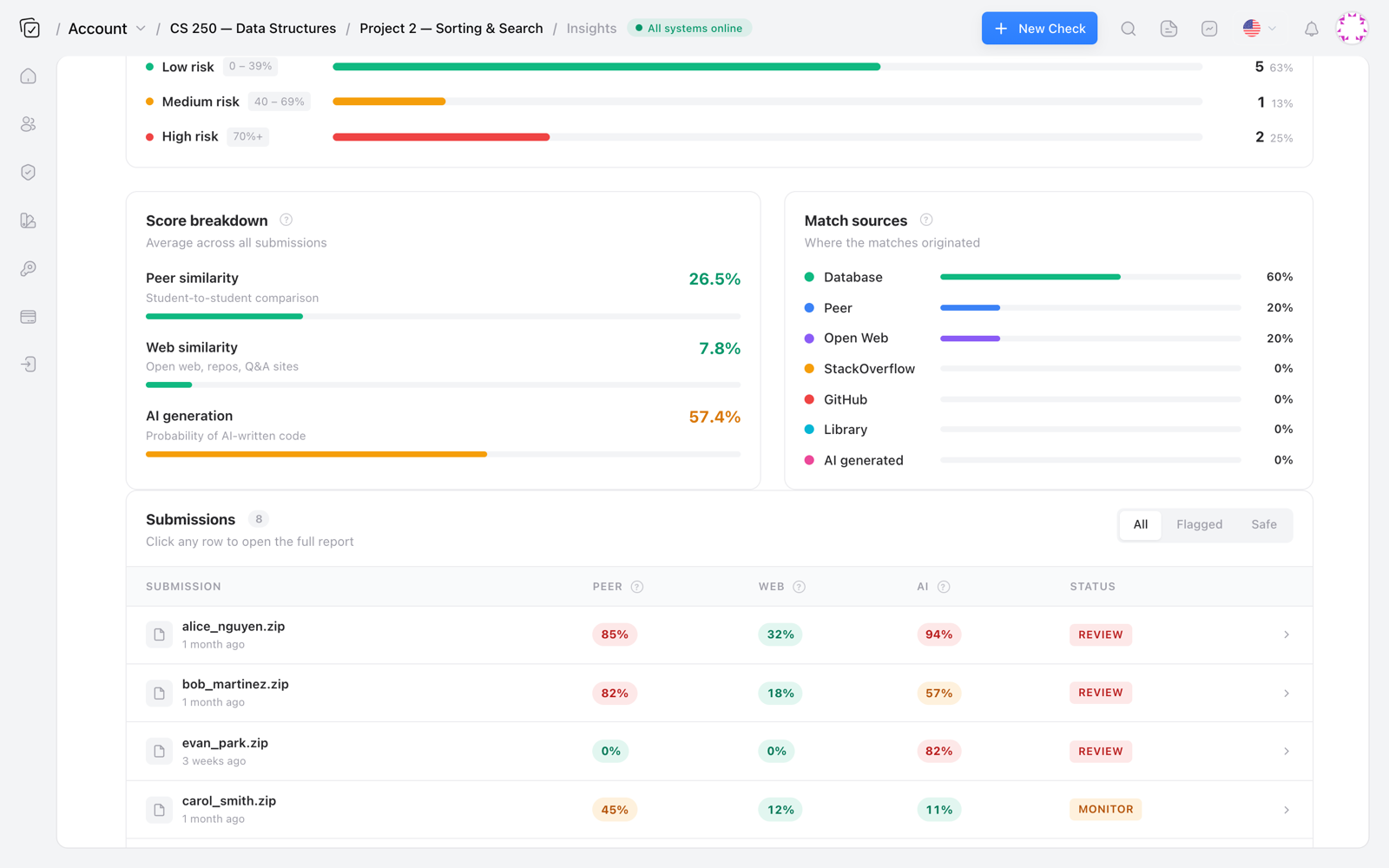
Jia Patel, a PhD candidate who has served as a head TA for a 400-person data structures course, said the most reliable signal was not the raw AI probability but the relationship between that probability and similarity to peer submissions and web sources. A file with a high AI score and a 91 percent peer match was usually a template or a shared starter file. A file with a low peer match and a high AI score deserved a closer look. That observation is now shaping how several universities use detection.
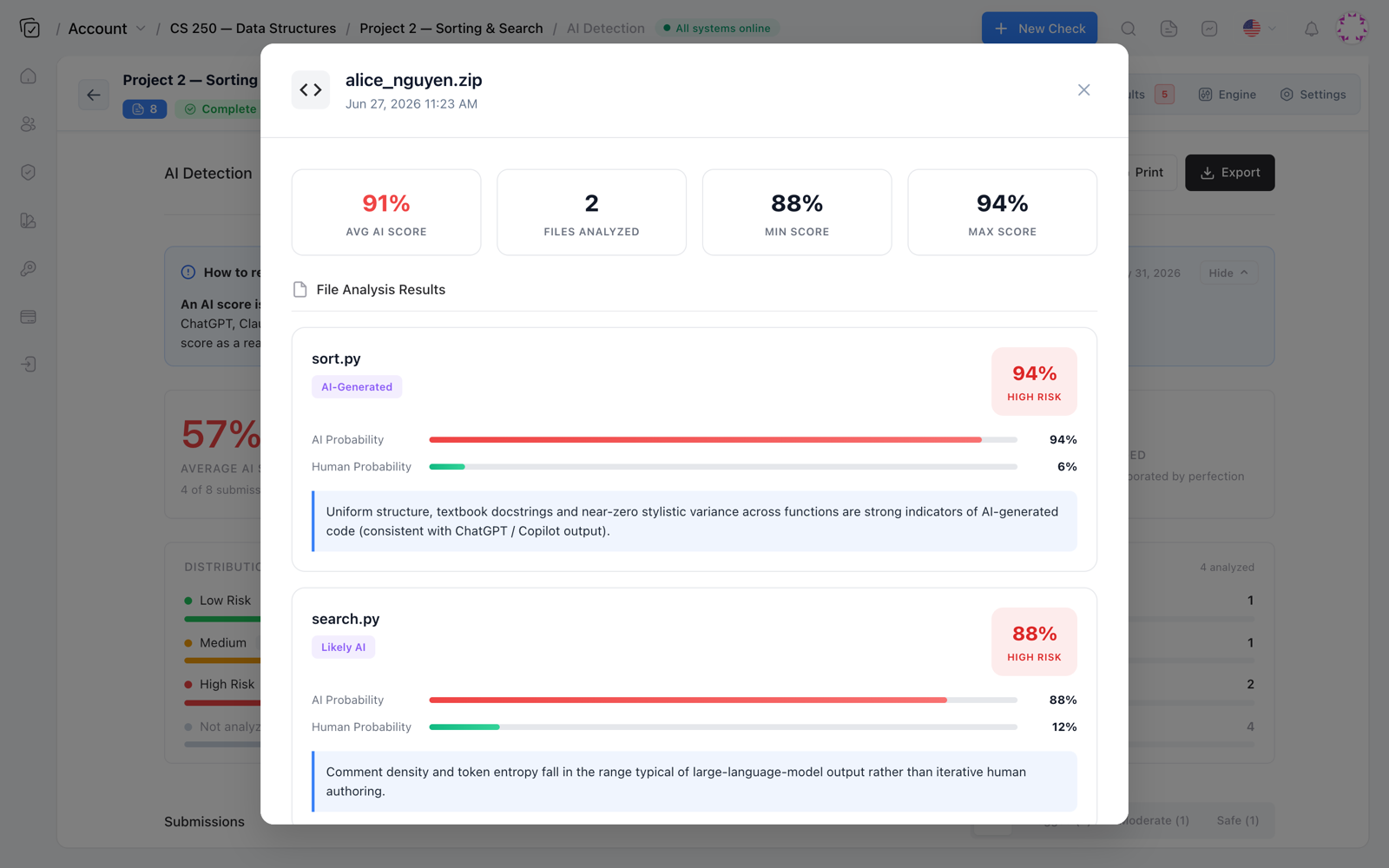
Codequiry's approach addresses this by showing each submission's peer similarity, web matches, and AI generation score side by side. A CS2 instructor at a technical college in Ohio who uses the platform said the combined view changed how she interpreted a high AI score.
A submission with a 91 percent peer match and a 78 percent AI score was almost always copied starter code. A submission with a 12 percent peer match, a 7 percent web match, and an 85 percent AI score warranted a conversation.
That reduction in false alarms matters in large courses. If a detector flags 22 percent of submissions and most of those are boilerplate artifacts, the review queue becomes useless. Instructors stop trusting it, and the actual cases get lost.
Stacking AI Detection With Structural Similarity
The most effective workflows found in spring 2025 use AI detection not as a verdict but as one signal in a stack. A code plagiarism checker that compares token sequences, ASTs, and fingerprints across peer submissions catches the student who copied a classmate's file and then renamed the variables. A web-source check catches code lifted from Stack Overflow or a public GitHub repository. The AI detector catches something different: text that shows the statistical signature of generation, even when no exact source exists.
When those signals disagree, the disagreement is often the most useful evidence. A large language model can produce code that is syntactically correct but oddly uniform, with no digressions, no commented-out experiments, and no half-finished alternative approaches. Students, even strong ones, leave traces. The absence of those traces, combined with a high AI probability and no match in the peer or web corpus, is a stronger signal than any single score.
Codequiry makes this stack practical because it runs peer similarity and web-source tracing in the same scan as its AI code detector. Other tools require separate submissions or different platforms for each kind of check. That separation is not just inconvenient; it breaks the comparison. If a detector returns only an AI probability for each file, the instructor has no baseline for whether the file is also a template, a peer copy, or a snippet from a tutorial site.
What Instructors Are Doing Differently in 2025
A few practical adjustments have spread quickly through teaching-focused Slack channels and regional CS education workshops. The most common is to strip the course template before running any detector. One TA at a California university wrote a small Python script that removed the instructor-provided scaffolding from each submission before sending the rest to the detector. Across three assignments, the false flag rate dropped from 27 percent to 11 percent. That is still not zero, but it moved the review burden from one in four files to one in nine.
Another shift is thresholding. Departments that used to treat any AI score above 70 as actionable now often set the review threshold at 85 or 90 and require a human to look at the file before any academic integrity case proceeds. Some honor boards now ask for a second detector or for the student to explain the code in a short interview. That last step catches two problems at once: the false positive and the true positive who cannot explain what the code does.
The technical fix is still incomplete. Detectors have gotten better at distinguishing boilerplate from generated code by comparing a submission to a baseline of starter templates, but the field has not settled on a standard for what should count as a false positive in code. A detector that flags a student's faithful reproduction of a course template is technically wrong, but it is also telling the instructor something true about the assignment: that the task did not require enough original work to distinguish students from a generator. Some faculty are taking that as a prompt to redesign assignments, not just to tune detectors.
For CS departments weighing these tools, the practical question is whether the detector helps a reviewer find the cases worth reviewing. A high AI score on a file that is 90 percent similar to every other submission is noise. A high AI score on a file that matches nothing else is signal. Platforms that separate those two numbers leave instructors to do that reasoning by hand. Ones that put them in the same report make the false positive problem visible, and visibility is the first step toward fixing it.
Instructors who want to see how combined peer, web, and AI scores change a review queue can start with the AI-generated code detector and the companion similarity checks.